FiaOS
FiaOS is a small Python web server you run on each of your computers. Open its page in any browser, log in once, and you get that machine's live screen and a real terminal. It runs on Apple Silicon Macs and on Windows 10/11, and several machines can sit behind one URL with one login.
There is no client to install and no cloud service in the path. You host it yourself.
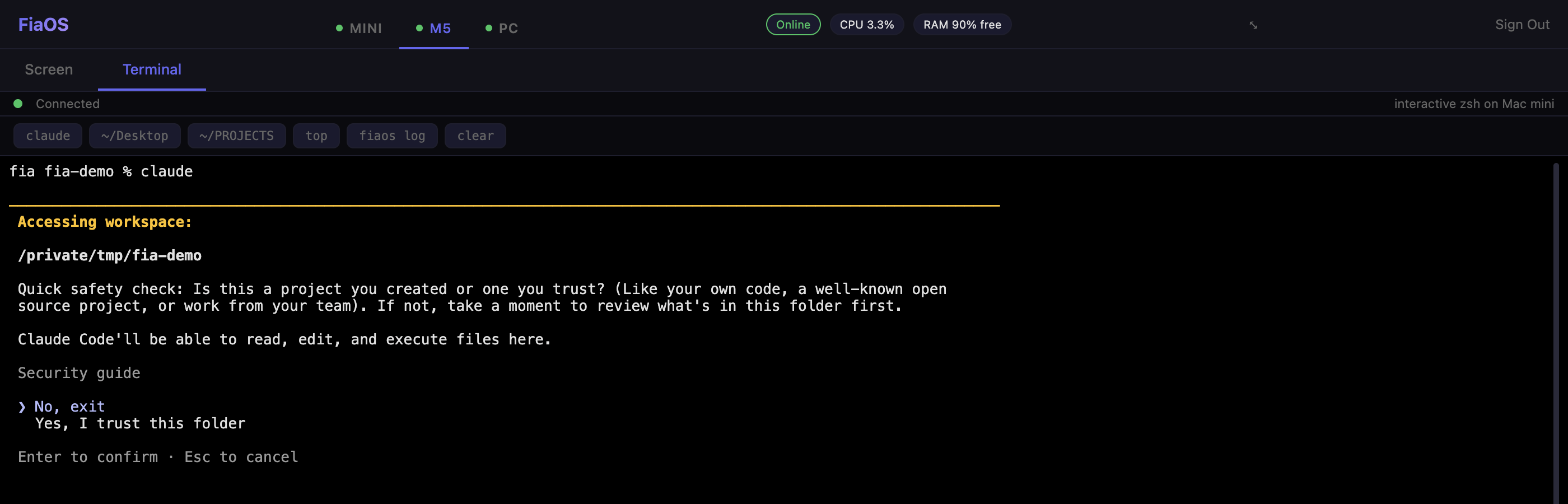
What you get
Screen. A live view of the desktop, streamed as 128 px JPEG tiles. Only tiles that changed are sent, so a still desktop costs almost nothing. Click, drag, scroll and type on it and the events go to the real machine.
Terminal. A real PTY. On macOS it is zsh -l -i behind pty.openpty(); on Windows it is PowerShell inside a ConPTY via pywinpty. Anything that needs a TTY works: claude, vim, top, htop, python -i. The browser side is xterm.js.
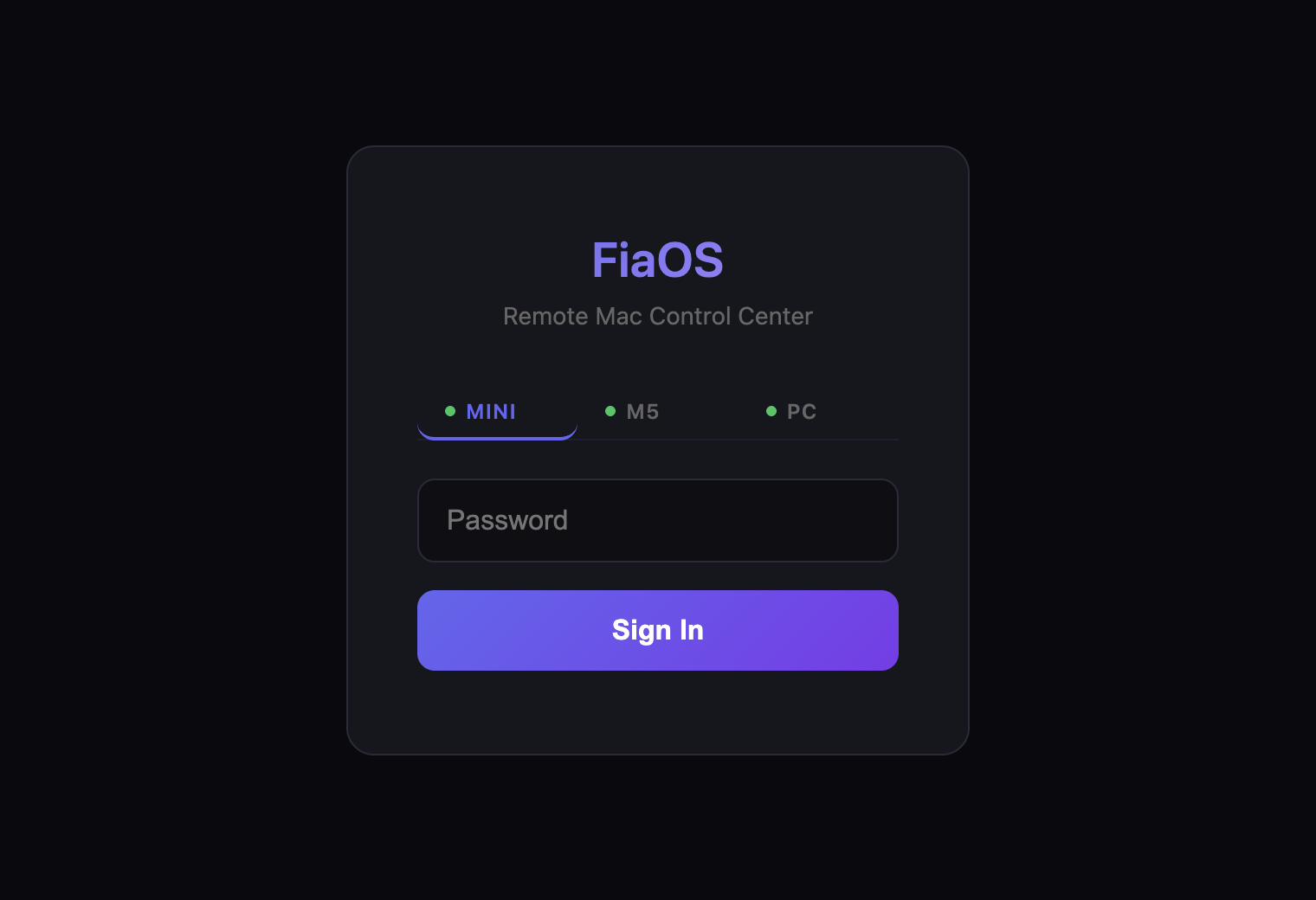
Machines. Tabs across the top (the shipped UI labels them Mini, M5 and PC). Picking one sets a fia_target cookie, and either nginx or the Windows server's built-in proxy sends you to that machine. Session tokens are signed with the shared password, so the login carries over.
Who it is for
- People running Claude Code (or any terminal tool) on a Mac or PC who want to drive it from a phone or another computer.
- Headless homelab setups: Mac minis or PCs with no monitor attached.
- Mixed Mac and Windows setups that want one page and one password for both.
- Anyone who wants to replace an SSH client plus a VNC viewer with a single web page they host themselves.
It is not a general multi-user remote access product. There is one shared password per fleet, and anyone who has it has the same power as an SSH login. See Configuration > Security notes.
On a phone
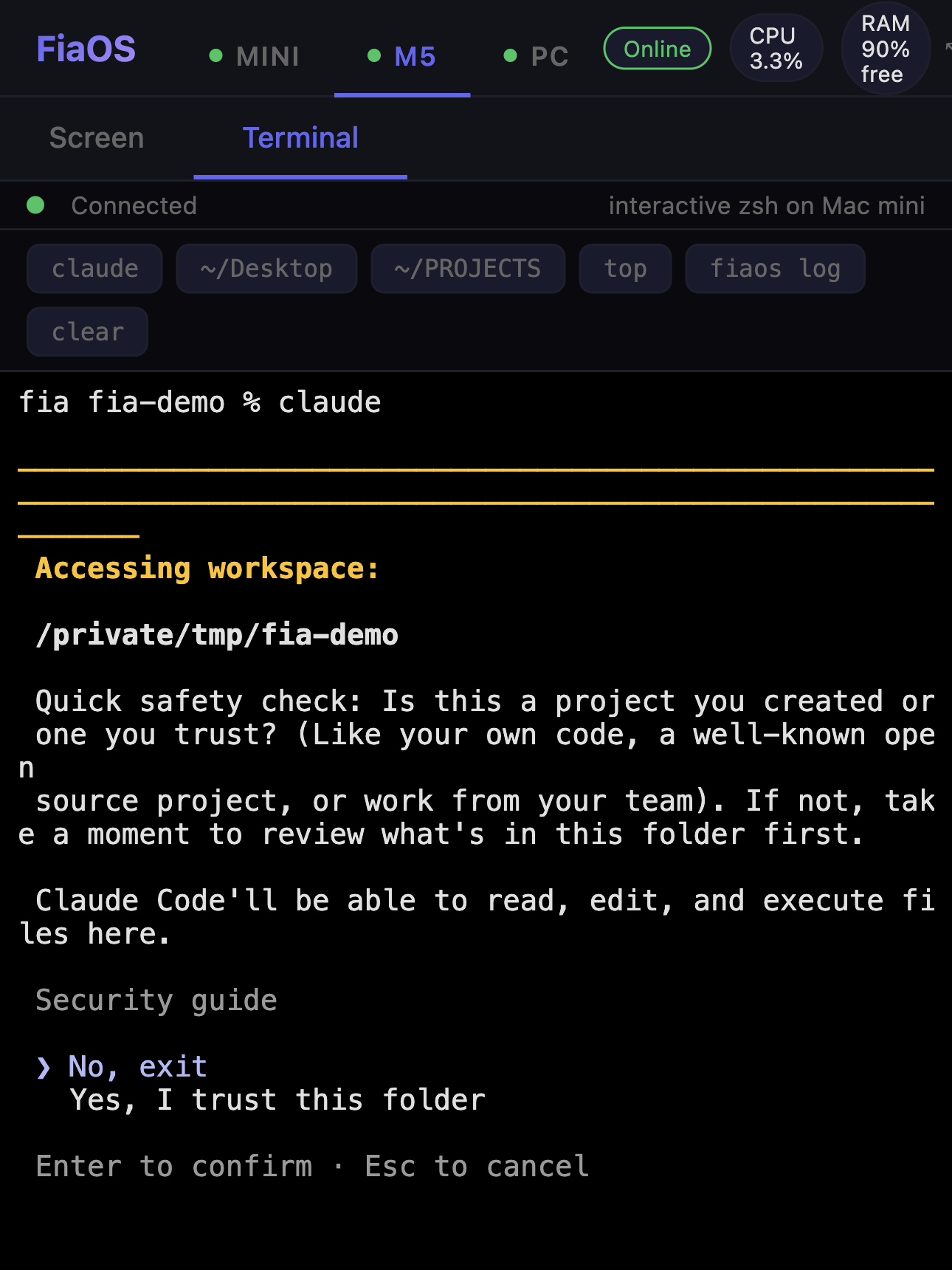
The screen view handles touch: one finger drags, two fingers scroll, a long press right-clicks (from static/index.html). When the page is opened from a non-LAN address, the browser asks for a smaller, lower-quality stream to save bandwidth.
Tested
The repo ships its own tests, described in tests/README.md:
tests/test_auth.pyruns auth and session checks against the realserver.pywith a throwaway password and temp state files. The test README and the main README both say 62 checks. A run while building these docs (Linux, Python 3.13, aiohttp 3.10) printedRESULT: 62 passed, 0 failed.tests/test_infra.shbreaks a live deployment on purpose (freezes the server, kills the tunnel, plants a zombie listener on the VPS) and measures recovery. It needs a real deployment to run.
Next steps
- Install on macOS or Windows
- Quickstart: from clone to a working terminal in the browser
- How it works: the screen pipeline, the PTY, signed sessions, multi-machine routing
- Source on GitHub: nicedreamzapp/FiaOS
FiaOS is built on other people's work, including xterm.js, aiohttp, psutil, pywinpty and PyObjC. Its natural-language helper calls the Anthropic Claude Code CLI. See Credits.