A Deep-Dive Story · Aquatic Restoration Ecology

The hands and eyes of marine restoration wear regulators.

Most of the work that brings a reef back from the dead happens 20 meters down, in cold dark water, by people running transect tape, gluing coral fragments, and counting fish by hand. This is scientific diving — and without it, modern aquatic restoration ecology would not exist.

13 chapters · ~12 minute read · scroll to begin
↓ dive in
CHAPTER 1 · WHAT IT IS

Diving for data, not for sport.

Scientific diving is SCUBA performed exclusively in support of research, education, or restoration — never for recreation, never for commercial pay. It is its own legal and professional category, regulated in the United States by an OSHA exemption and governed by the American Academy of Underwater Sciences (AAUS).

A scientific diver doesn't go down to look — they go down to do work: lay a transect, photograph a quadrat, hand-plant coral fragments, count urchins, collect a water sample, retrieve a hydrophone. The dive is the lab visit.

AAUS-credentialedOSHA exemptResearch only
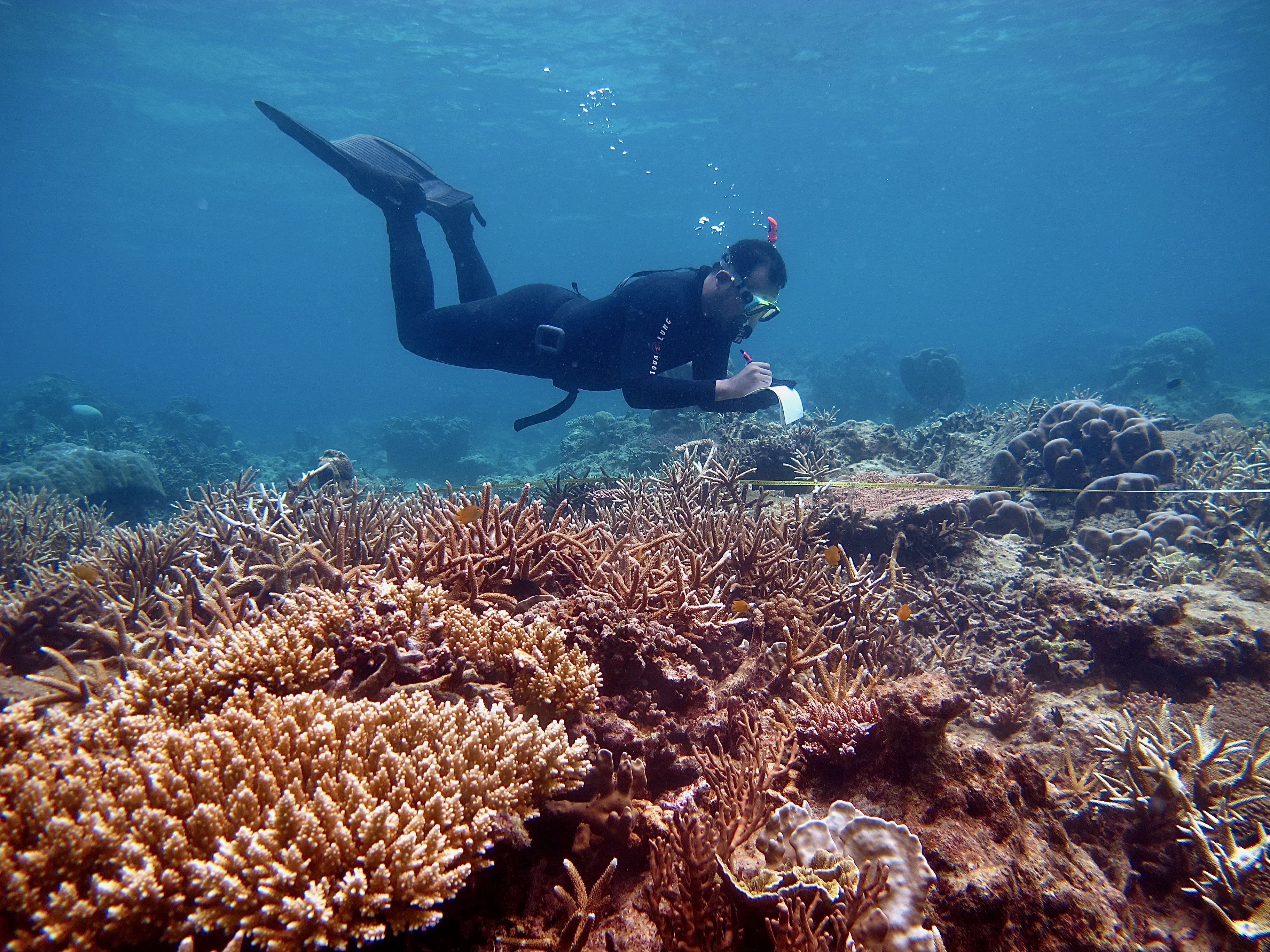
A shallow tropical reef — the kind of habitat where most restoration diving takes place
Karimunjawa shallow reef · Wikimedia Commons
CHAPTER 2 · WHY HUMAN DIVERS

Robots can see. Divers can act.

ROVs and drones have transformed deep-water observation, but most aquatic restoration work is in the upper 30 meters — and at that depth, a trained human is faster, cheaper, and more delicate than any robot.

Restoration is hand work. A diver can:

  • Glue a 2 cm coral fragment onto reef rock with marine epoxy.
  • Tease apart bleached Acropora for microfragmentation.
  • Hand-plant seagrass shoots into bare-root anchors.
  • Spear an invasive lionfish without disturbing its neighbors.
  • Identify a juvenile parrotfish by eye, in 3 seconds, while it darts past.

ROVs cannot do any of those reliably. Not yet.

CHAPTER 3 · BECOMING ONE

Hours, not weekends.

Recreational SCUBA certification takes a long weekend. AAUS scientific-diver certification takes about a hundred hours of training plus 12 supervised training dives, a written exam, dive physiology, dive medicine, rescue, and a working understanding of decompression theory.

After certification, divers are depth-rated incrementally — 18 m, 30 m, 40 m, 45 m, 60 m — by accumulating logged dives at each depth under a Diving Safety Officer's supervision. A new diver cannot just decide to work at 30 m; they have to earn that depth tier by tier.

Programs at Smithsonian, Scripps, NOAA, Woods Hole, and dozens of universities operate under AAUS reciprocity — letting researchers dive at partner institutions anywhere in the world.

AAUS StandardsOSHA exemptionReciprocity
Confined water · pool 18 m · open water 30 m · earned tier 40 m+ · advanced
CHAPTER 4 · THE BREAD AND BUTTER

The transect is the laboratory.

Roll out a 30-meter fiberglass tape. Anchor it to the reef. Two divers swim along it, one on each side. One records every coral colony intersected by the tape (point-intercept transect). The other counts every fish within a 2-meter belt either side and estimates length to the nearest centimeter.

Repeat at the same site in March, June, September, December, year after year. Within five years you have a population trajectory. Within twenty, you have a record that no satellite, no drone, and no ROV can match.

Quadrat photography works the same way: a 1×1 m PVC square, a strobe, an SLR housing. Point-counts are scored later in the lab using software like CoralNet or CPCe.

Point-interceptBelt transectPhoto-quadrat
0m 15m 30m
CHAPTER 5 · CORAL UP CLOSE

Glue. Wait. Watch a forest grow.

Branching corals like Acropora cervicornis can be grown in underwater tree nurseries — PVC trees with monofilament arms, each holding a 5-cm fragment. After 6–9 months a fragment becomes a 30-cm colony.

Divers cut, tag, hang, and eventually outplant these fragments onto degraded reef. The technique is wonderfully low-tech: epoxy putty, a wire brush, a hammer, and a sharp eye for substrate.

For slow-growing massive corals (Orbicella, Diploria), practitioners now use microfragmentation — chunks just 1 cm across, which trigger a wound-response that grows them 5–25× faster than normal. A diver who plants 200 microfragments today is planting a coral head ten years ahead of schedule.

Acropora cervicornisMicrofragmentationTree nursery
Acropora coral — a branching genus that responds especially well to fragmentation
Acropora pulchra · Wikimedia Commons
CHAPTER 6 · MEADOWS BY HAND

Planting the underwater prairie.

Seagrass restoration is the patient sibling of coral work. Two methods dominate, and divers run both:

Bare-root planting: a diver harvests donor shoots from a healthy meadow, swims to the bare site, and presses each shoot into the sediment with a burlap or paper anchor that biodegrades in a season. Each diver can plant ~250 shoots per dive.

Seed broadcasting: in the Virginia Coast Reserve project — the largest seagrass restoration on record — researchers spread over 70 million Zostera seeds across decades, recovering more than 9,000 acres of meadow from a system extirpated by disease in the 1930s.

Light is almost always the limit. If water clarity drops, no amount of planting will help — the divers' first job is often diagnosing why a meadow died.

Zostera marinaBare-rootSeed broadcast
Zostera marina — eelgrass — the workhorse seagrass of temperate restoration
Zostera marina (eelgrass) · Wikimedia Commons
CHAPTER 7 · LIVING FILTERS

Building a reef shell by shell.

Oyster reefs in Chesapeake Bay sit at less than 1% of their pre-colonial biomass. Restoration deploys recycled shell (cultch), limestone, or concrete as settlement substrate, then seeds it with hatchery spat. Divers monitor the reefs for vertical relief, density, and recruitment.

A single adult oyster filters up to 50 gallons of water per day. A restored reef the size of a city block is, ecologically, a small wastewater plant — and a fish nursery, and a wave break, all at once.

Modern oyster restoration is increasingly 3D-printed — modular, textured units cast specifically to mimic the rugosity wild reefs build from their own shells.

Crassostrea virginicaCultch & spat3D-printed reefs
An exposed oyster bed showing the dense, three-dimensional structure restoration aims to rebuild
Oyster bed · Wikimedia Commons
CHAPTER 8 · UNDERWATER PEST CONTROL

Sometimes restoration is a pole spear.

In the western Atlantic and Caribbean, lionfish (Pterois volitans) — released from aquaria in the 1980s — have decimated native reef-fish biomass. They have no natural predators in their introduced range. The management response has been almost entirely diver-led: spearfishing derbies, Z.E.A. (Zoo and Aquarium) cull events, and ENGO partnerships like Reef Environmental Education Foundation's lionfish program.

On the Great Barrier Reef the equivalent is the crown-of-thorns starfish (Acanthaster planci) — coral-eating, periodically eruptive, and ecologically devastating during outbreaks. The Australian Institute of Marine Science runs a year-round dive culling program, injecting individual stars with bile salts.

It's the messiest, most physical end of restoration ecology. There's no graceful way to spear a lionfish. There's no dignified way to hold an injection gun against a star covered in venomous spines.

Pterois volitansCOTS injectionDiver-led management
CHAPTER 9 · 3D FROM 2D

Flying transects to build a reef in software.

Structure-from-motion photogrammetry turns a diver's camera into a sub-millimeter mapping rig. The diver swims a slow, overlapping lawnmower pattern over a reef section — typically 20×20 m — snapping a photo every meter. A few thousand images later, software like Agisoft Metashape or RealityCapture stitches them into a textured 3D mesh.

Researchers can now measure rugosity (surface complexity), coral volume, and individual colony growth between visits with the same precision a forester measures trees. A reef in 2024 vs. the same reef in 2027 is a comparison of two 3D models.

The diving is harder than it sounds: depth, current, and battery all compound. The data, once processed, is pristine.

Structure-from-motionRugosityTime-series 3D
LAWNMOWER PATTERN · 20×20 m
CHAPTER 10 · THE RIGOR

Why the protocol is sacred.

The water doesn't care about your hypothesis. Every dive carries risks recreational divers rarely confront at this intensity:

  • Decompression sickness — nitrogen bubbling out of tissues during ascent. Mitigated by computers, mandated safety stops, and surface intervals.
  • Nitrogen narcosis — the cognitive impairment that starts around 30 m. A diver may forget to record the data they came to record.
  • Pulmonary barotrauma — lung overexpansion injury if you hold your breath ascending.
  • Entanglement — transect tape, kelp, fishing line, derelict gear.

AAUS-regulated programs require a Diving Safety Officer, a Diving Control Board, dive plans pre-filed for every operation, emergency oxygen on the dive boat, paired buddy diving, and an annual physical exam. Recreational programs require none of that.

The result is a remarkable safety record — fatality rates an order of magnitude lower than recreational diving.

DSO oversightBuddy systemPre-filed plans
SURF 5 m · stop 10 m 20 m 30 m · narcosis line 3-min safety stop
CHAPTER 11 · WHO BUILT THIS

The institutions behind the mask.

Scientific diving in its modern form was built largely in the 1950s–70s by researchers at Scripps Institution of Oceanography and Woods Hole Oceanographic Institution, who pushed the regulatory case that science required different rules than commercial diving. They won that fight in 1982 — the OSHA scientific-diving exemption.

Major programs to know:

  • AAUS (1977) — credentialing body, ~140 member institutions.
  • NOAA Diving Program — federal scientific diving across all agency missions, from sanctuaries to fisheries surveys.
  • Smithsonian Scientific Diving — runs the Caribbean coral and Pacific reef monitoring time-series at STRI and partners.
  • Reef Check — citizen-science protocol that scaled trained recreational divers into a global reef-monitoring network.

The infrastructure is the unsung half of the science. Without these institutions, an individual researcher's question never makes it underwater.

AAUSNOAASmithsonianReef Check
The Great Barrier Reef from the International Space Station — the kind of system these programs work on
Great Barrier Reef from the ISS · NASA / Wikimedia Commons

Tools of the trade

Dive slate

White acrylic, pencil-friendly underwater. Where every fish count, urchin tally, and "we should re-buoy this" idea actually goes.

Transect tape

30 m fiberglass, weighted reel. The single most-used scientific dive tool. Anchors the experiment to the reef.

Quadrat

1×1 m PVC frame. Drop, photograph, score every point of intersection in software. The unit of comparison across sites and decades.

Lift bag

Inflatable polyurethane balloon. Recovers heavy gear (artificial reef modules, lost moorings, dropped tanks) by displacement.

Camera housing

Aluminum or polycarbonate. Holds a mirrorless or DSLR rated to 60 m. Most photogrammetry rigs add twin strobes on long arms.

12.4 m 23 min

Dive computer

Tracks depth, time, ascent rate, no-decompression limit. Required by AAUS protocol on every research dive — and on every diver.

Surface marker buoy

Inflatable safety sausage. Deployed on ascent so the boat — and other boats — know where divers are coming up. Mandatory in current.

SCUBA cylinder

Aluminum 80 cu ft is the workhorse — about 60 minutes of bottom time at 10 m, 25 minutes at 30 m. Filled to 207 bar (3000 psi).

1977
AAUS founded
~100 hr
Training to certify
5–25×
Microfrag growth boost
9,000+
Acres of seagrass restored, VA

Without divers, there is no marine restoration.

Every restored reef, every replanted meadow, every cleared lionfish derby in the Caribbean is a story written one dive at a time, by people willing to do careful work in a place humans were never built to be.

If you're considering this path: AAUS-affiliated universities are the front door. Most programs welcome volunteer field assistants well before you're ready to dive yourself.