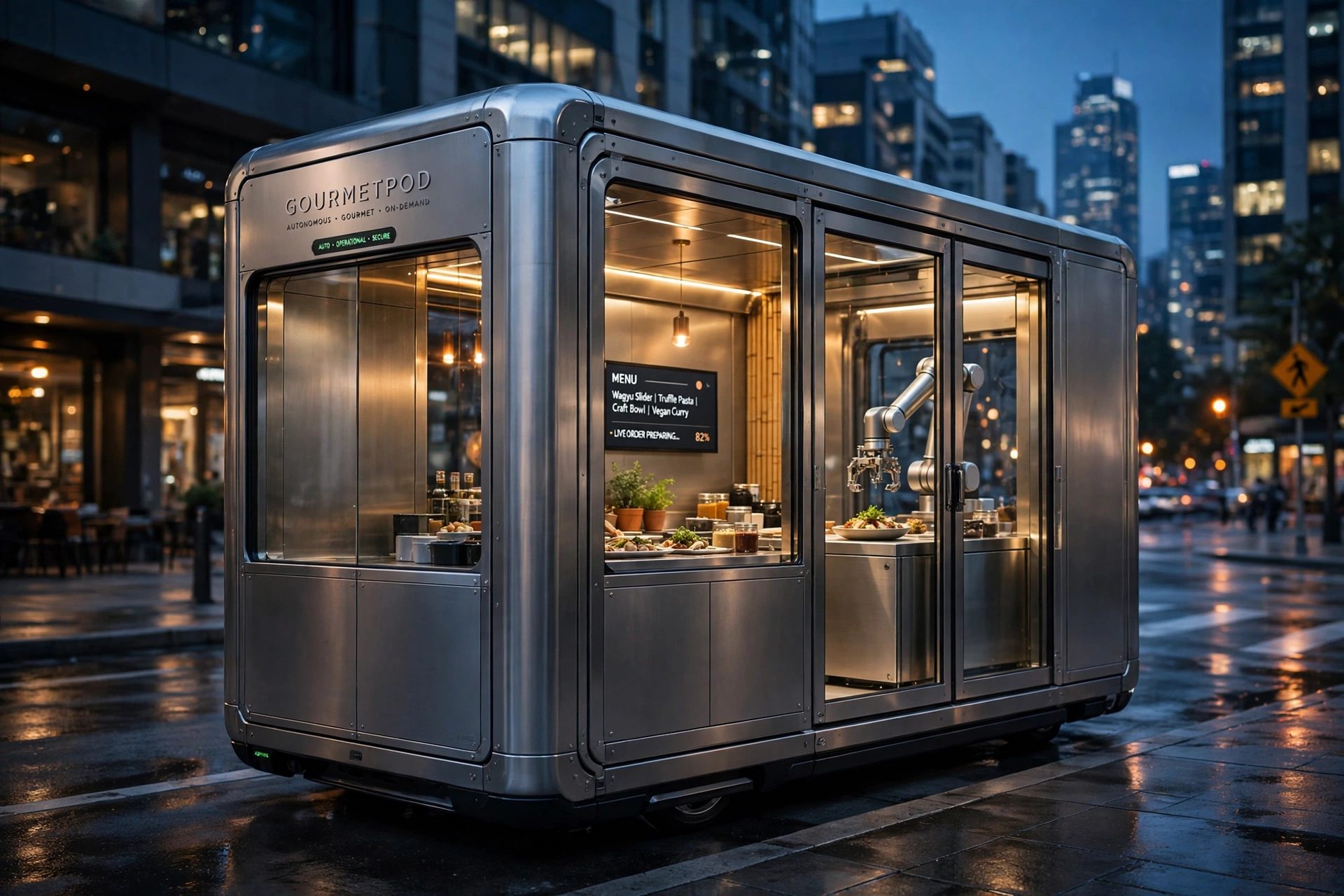
Bring the cost of food down for people who like to eat out.
A big share of a restaurant bill pays for the kitchen around the food: rent, buildout and staff. The pod shrinks all three. What it keeps spending on is the ingredients.
What it means at the counter
Spec estimates, not measured resultsAnd for whoever owns one
From the revised brochure. These are early estimates built on list prices. The audit uses more conservative figures, and reconciling them is an open issue.
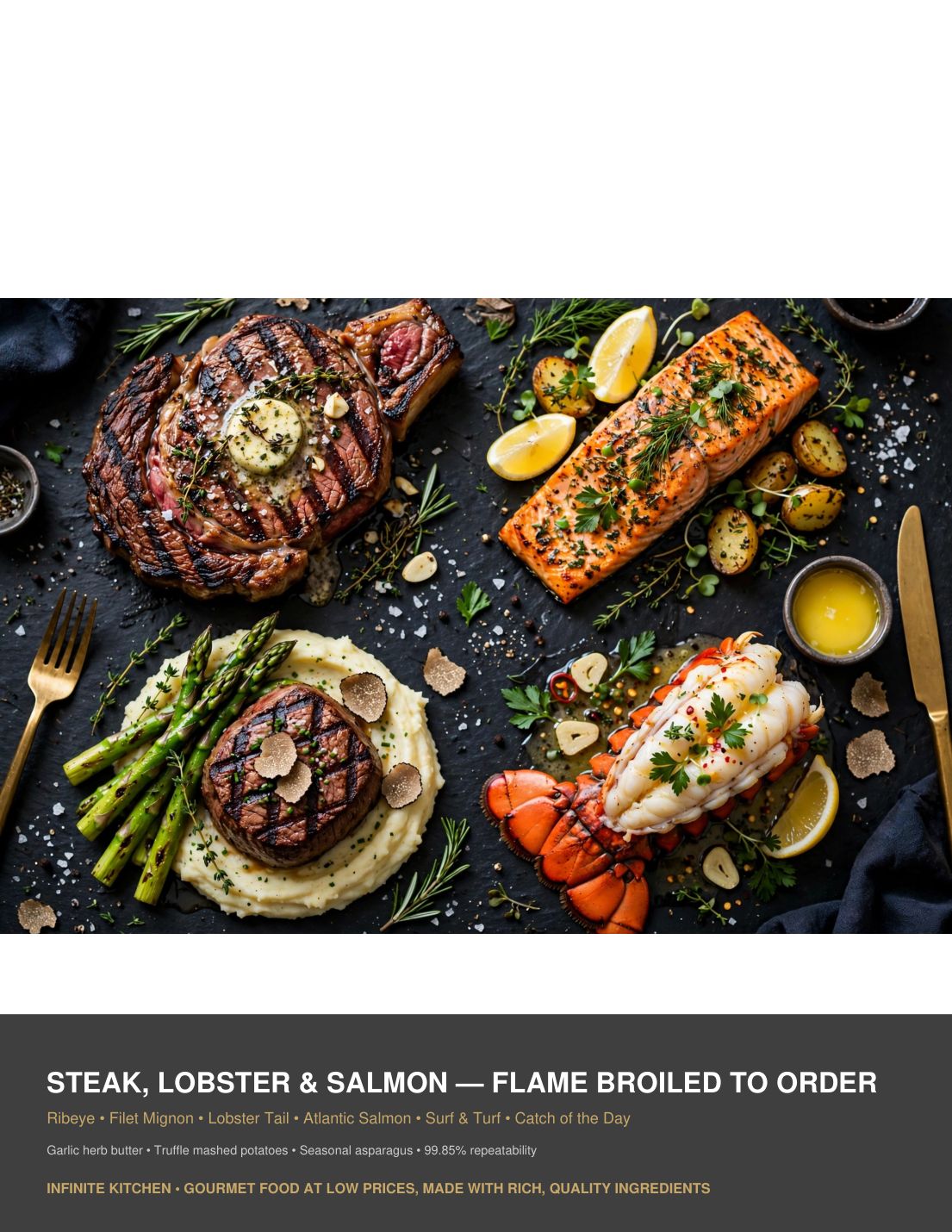
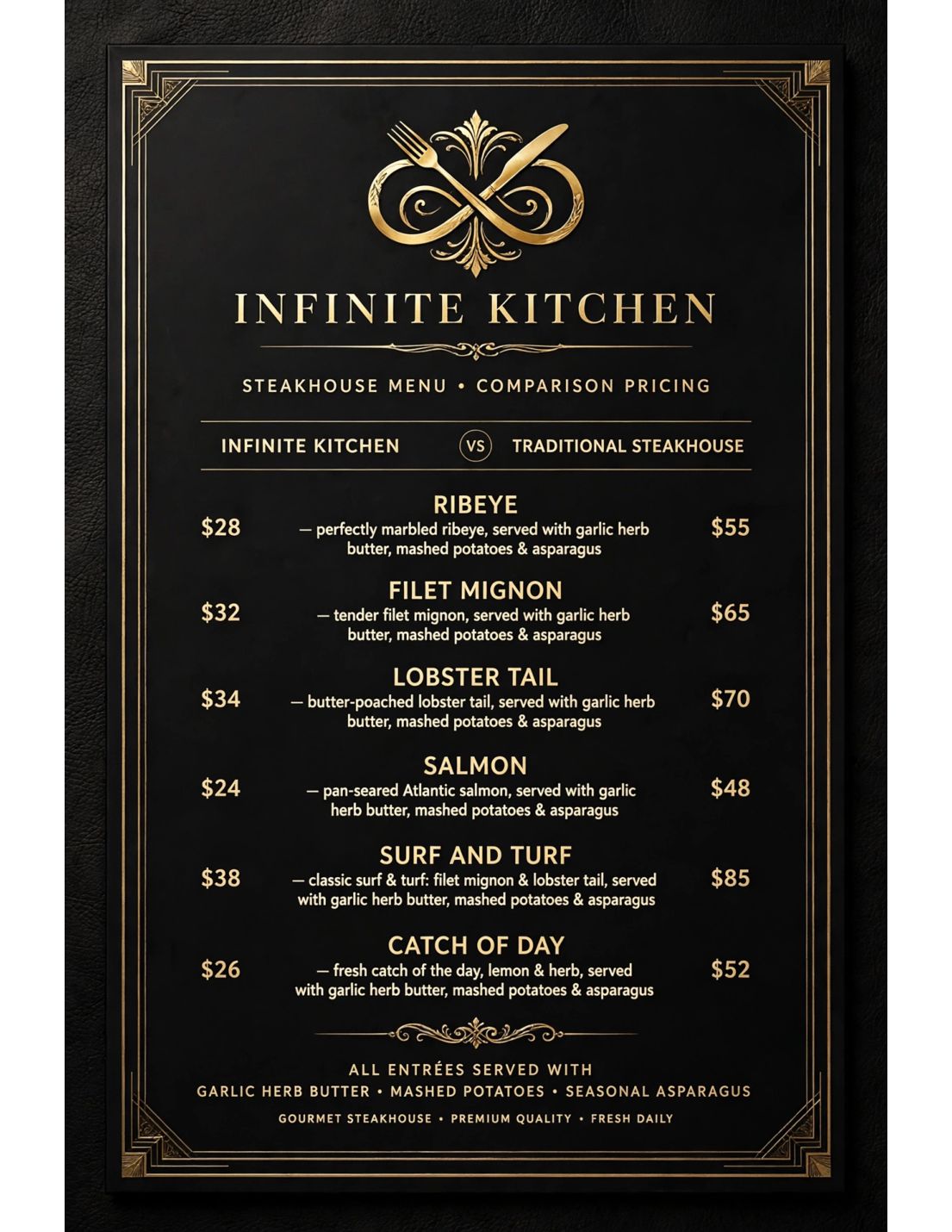
Steakhouse dinners at about half the price.
Rich, quality ingredients: ribeye, filet, lobster and salmon, flame broiled to order. Every plate comes with garlic herb butter, mashed potatoes and seasonal asparagus. The kitchen is what got cheaper, not the food.
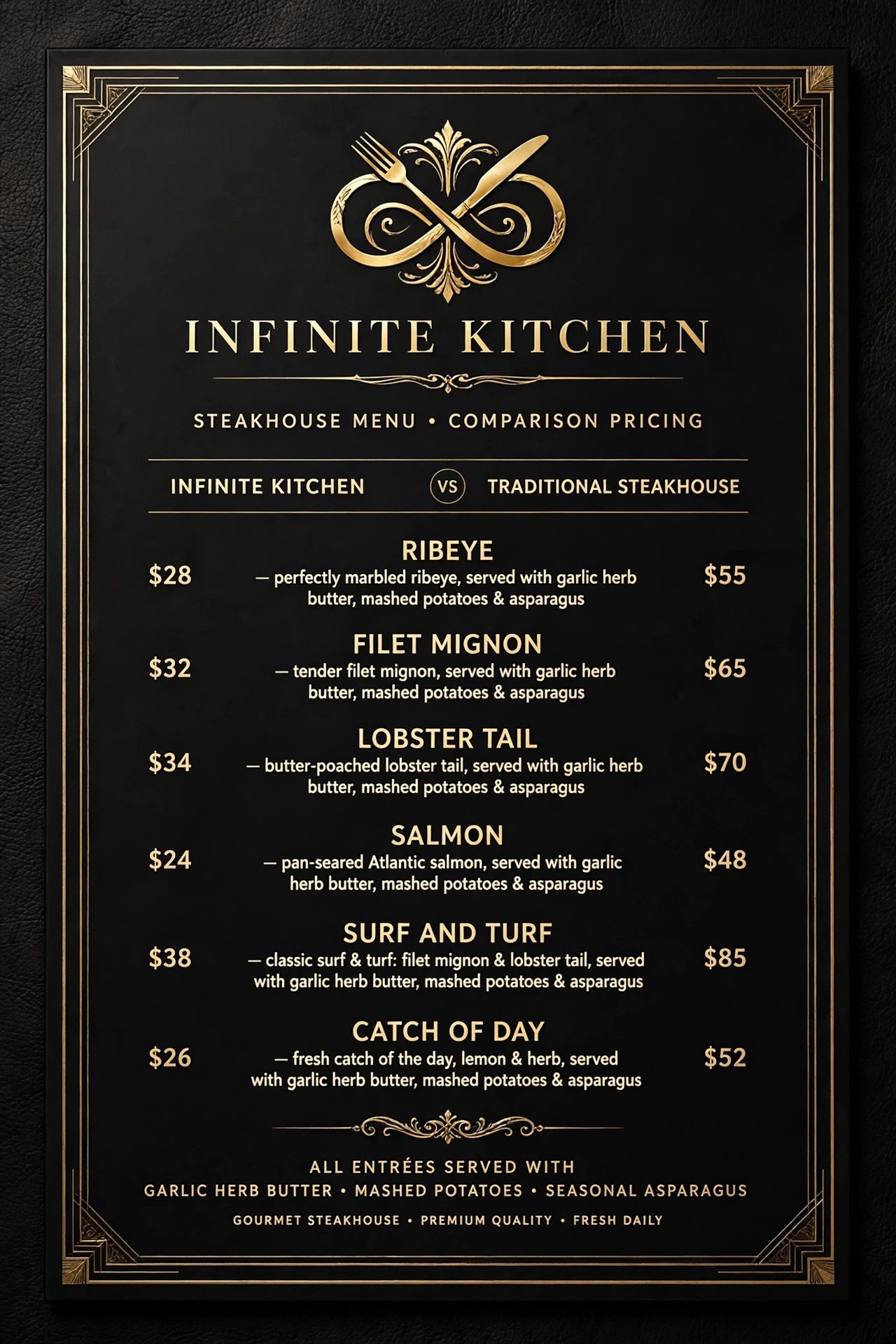
Ribeye
Marbled ribeye, garlic herb butter
Filet mignon
Tender filet, garlic herb butter
Lobster tail
Butter-poached lobster tail
Salmon
Pan-seared Atlantic salmon
Surf and turf
Filet mignon and lobster tail
Catch of the day
Fresh catch, lemon and herb
Steakhouse prices are illustrative comparisons from the brochure, not quotes from a specific restaurant. Pod prices are planned menu prices.
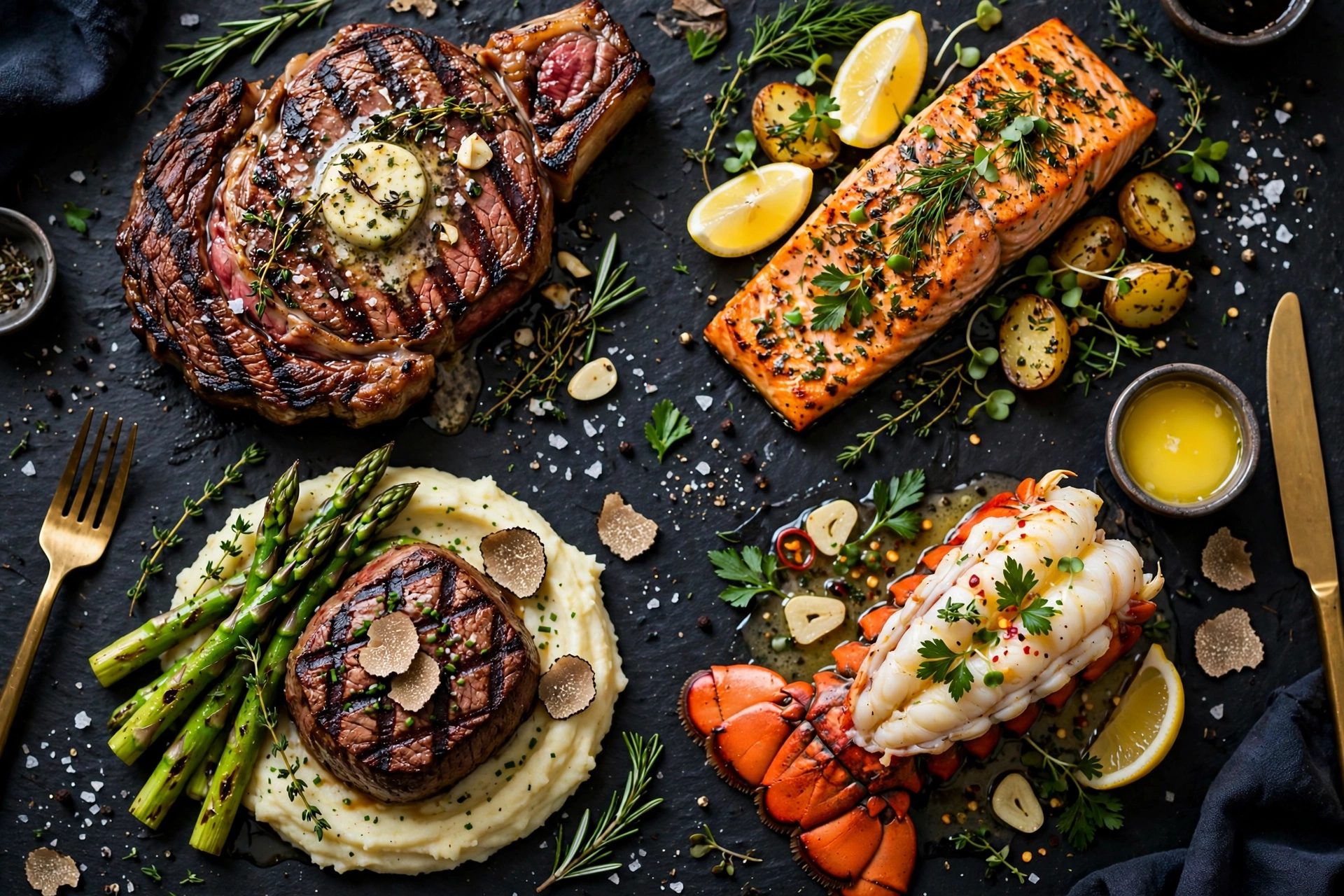
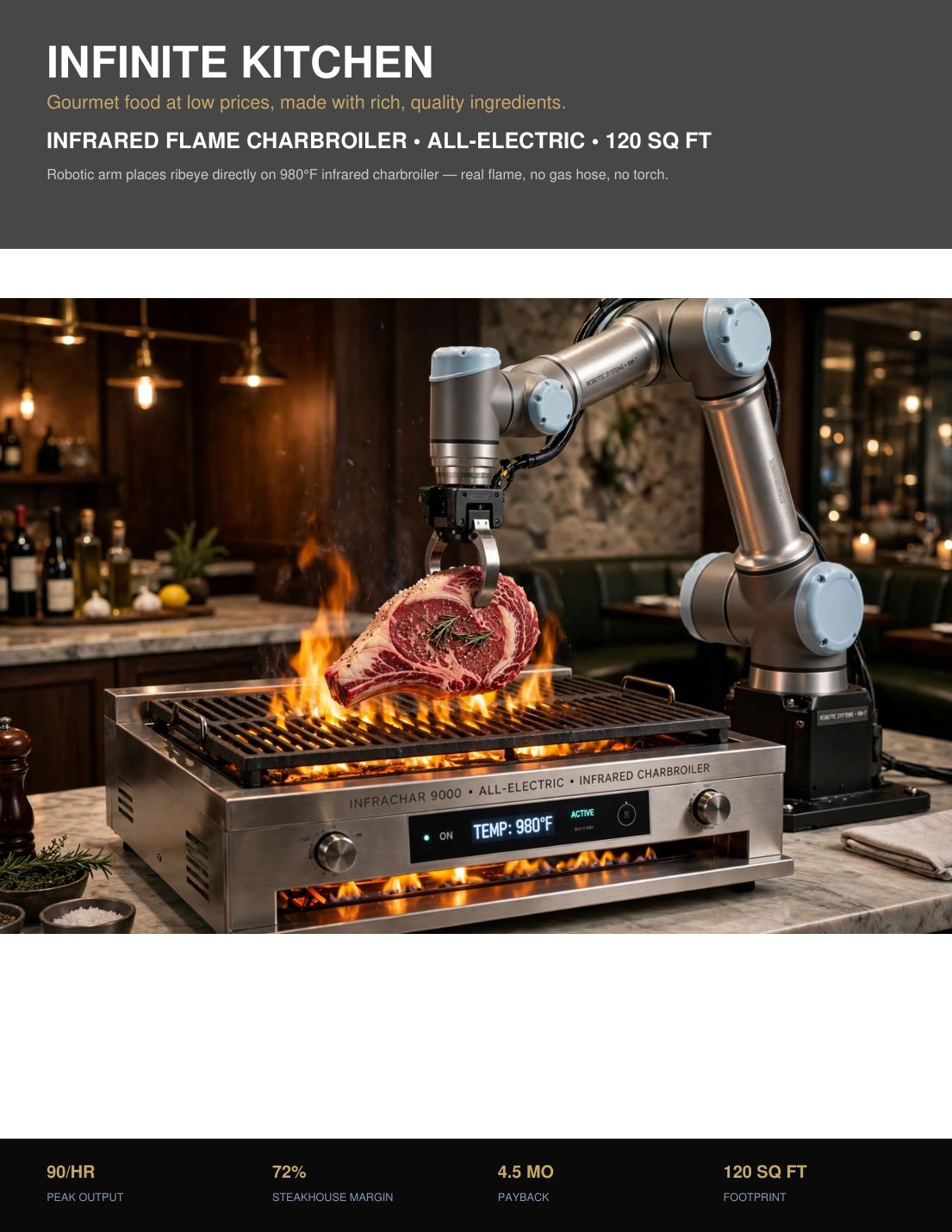
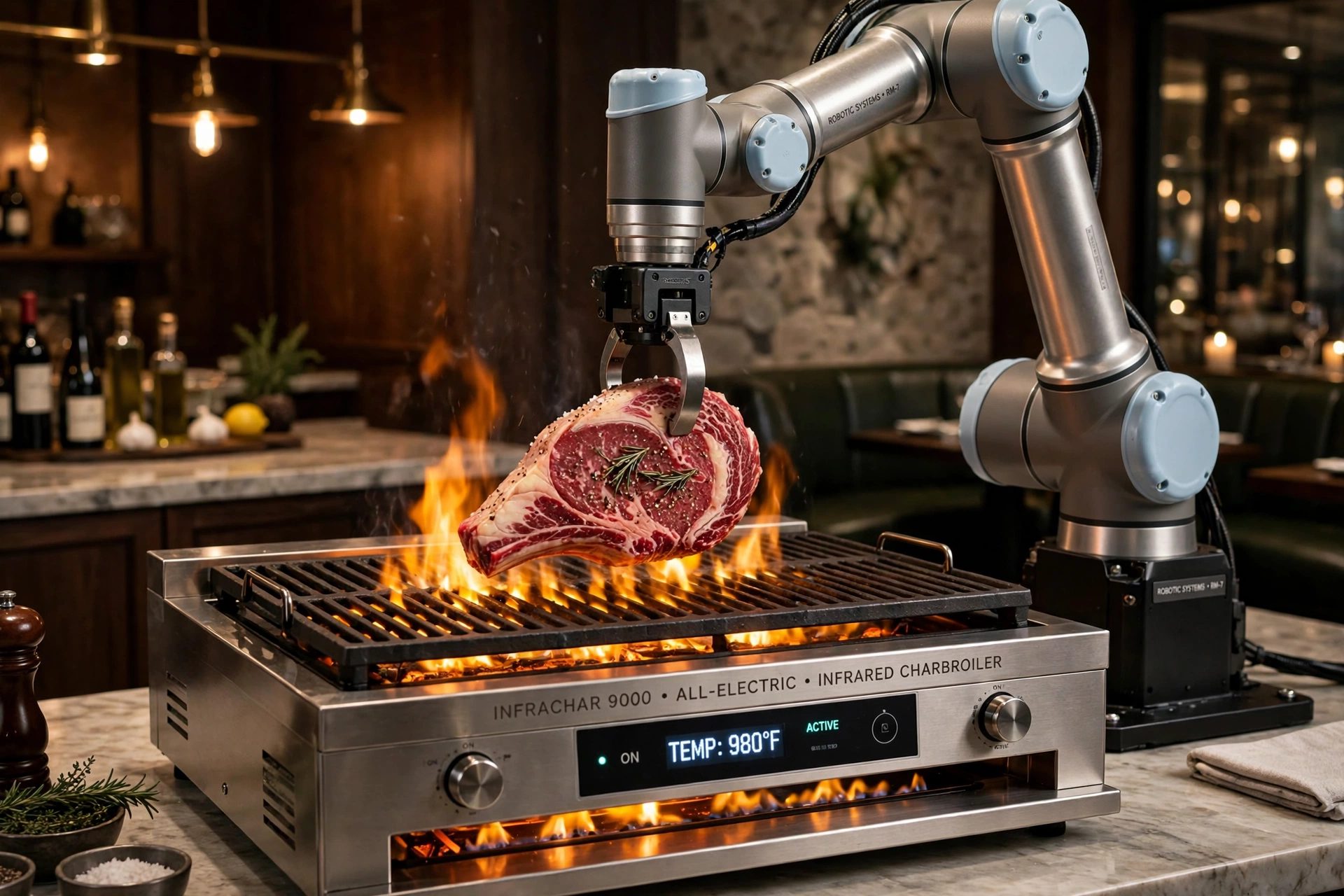 Fig 00 / Flame grill
A 980°F charbroiler with no gas hose.
The arm lays the steak straight onto an electric infrared charbroiler running at 980°F. Steakhouse char, no gas line, no torch.
- All electric: runs on the pod's 480V 3-phase supply.
- Flame broiled to order: ribeye, filet, burgers, chicken, seafood.
- 99.85% repeatability: the same sear on the hundredth steak as the first.
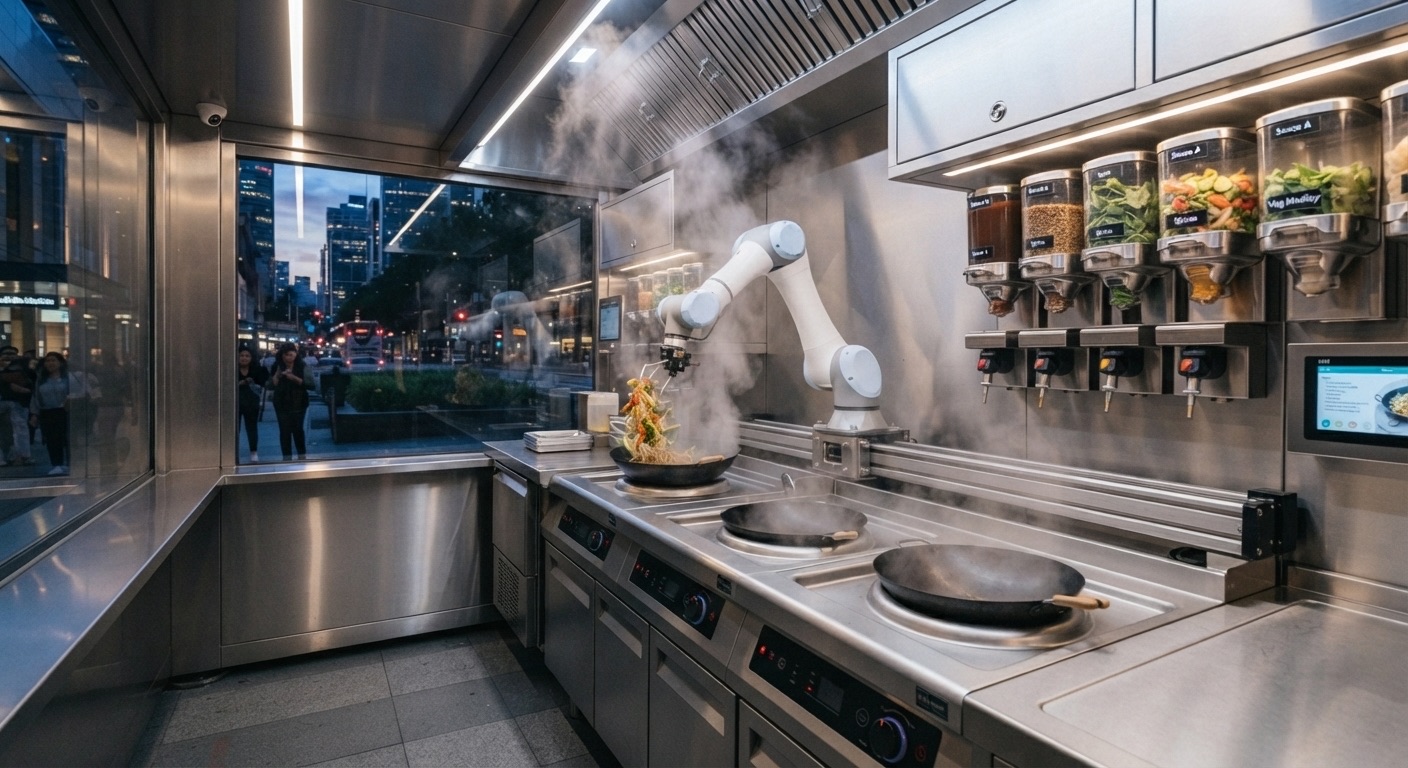 Fig 01 / Ingredients
Cheaper because it's automated, not because it's worse.
The savings come out of rent, buildout and labor, never the food. A refrigerated zone keeps fresh ingredients at 34 to 38°F, and every portion is weighed.
- Fresh, restocked daily. A person loads standard ingredient cartridges and sauce lines once a day.
- Weighed to half a gram. Load-cell dispensers put the full portion in every bowl, every time.
- 28% of the ticket. Food stays the biggest line item the model spends on.
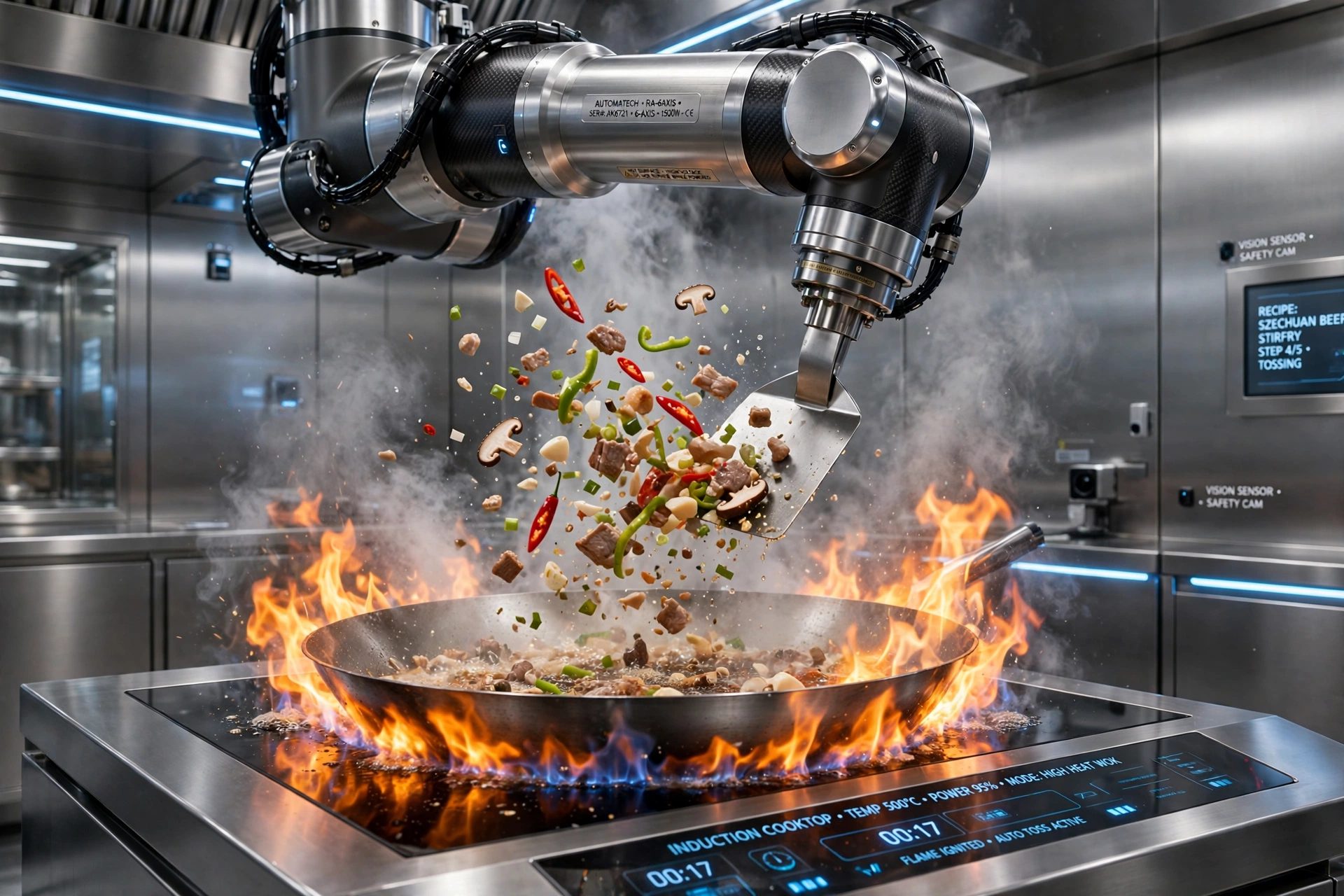 Fig 02 / Cooking
Real wok heat, two pans at once.
A 6-axis collaborative arm rides a linear track between two 5 kW induction woks and a ventless multi-cook oven, interleaving meals so neither pan sits idle.
- 600°F wok sear in seconds, with a tossing motion for real wok hei.
- Four modes: wok, steam and bake, chilled bowls, and sealed packing.
- About 38 seconds a meal on paper. Proving it on a prototype is open issue 2.
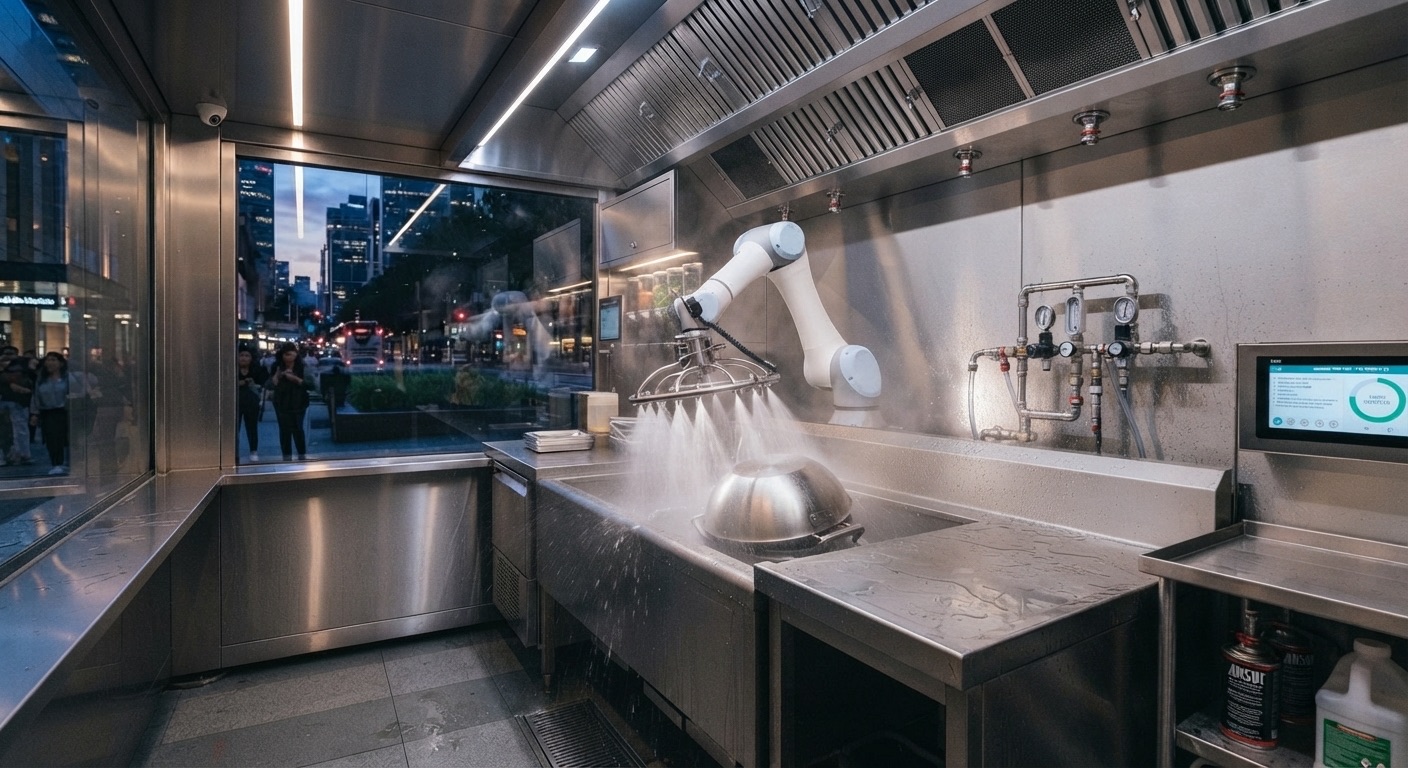 Fig 03 / Self-cleaning
It washes itself after every single meal.
No dish pit, no closing shift. A 3-stage wash runs between orders, and a full clean-in-place cycle sprays down the whole cell off-peak.
- Hydro-blast: a 60 PSI hot water jet clears the bulk.
- Ultrasonic dip: 40 kHz cavitation with a food-safe sanitizer.
- 180°F rinse: a final hot rinse aimed at a 5-log pathogen reduction.
- Sloped 316L basin with a 2 inch air gap to the drain.
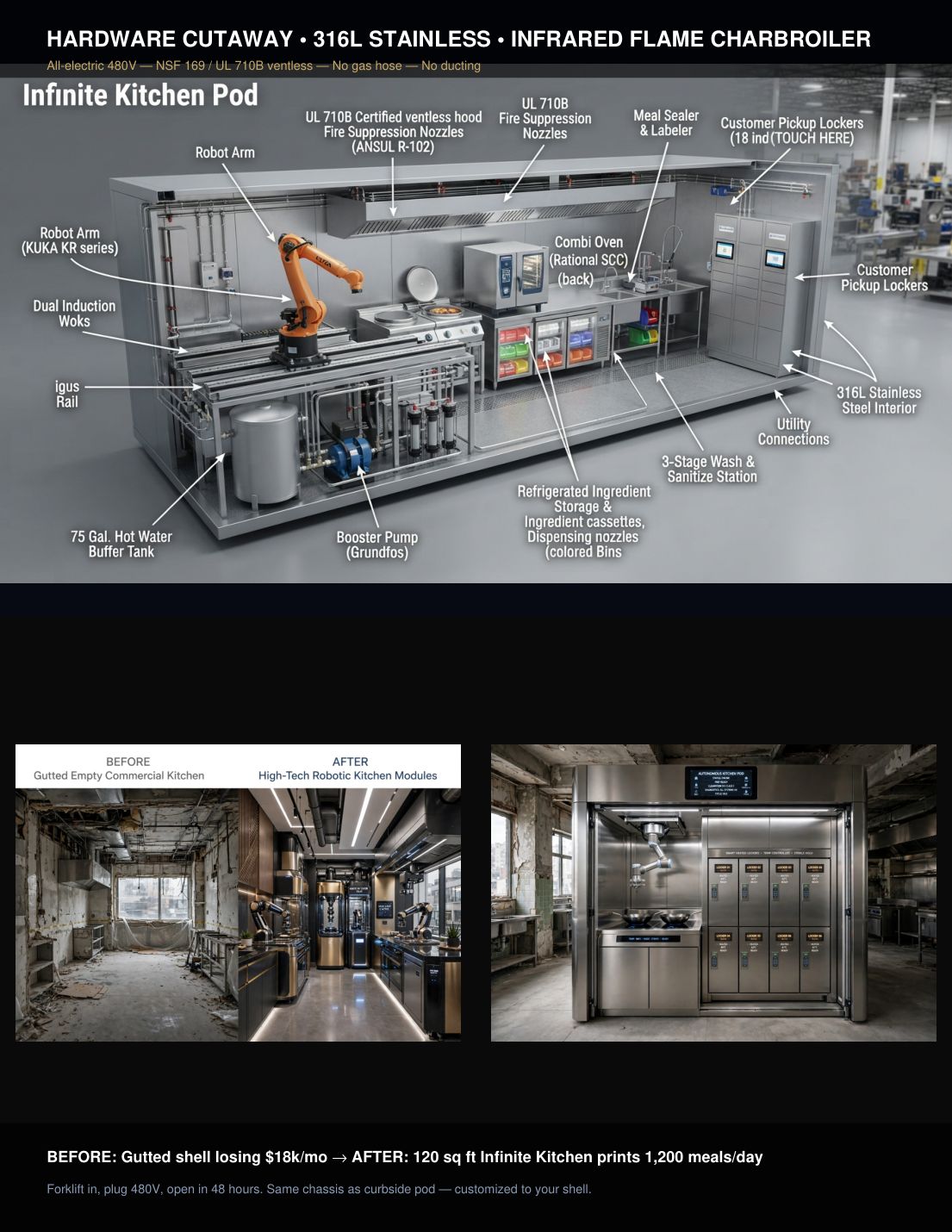
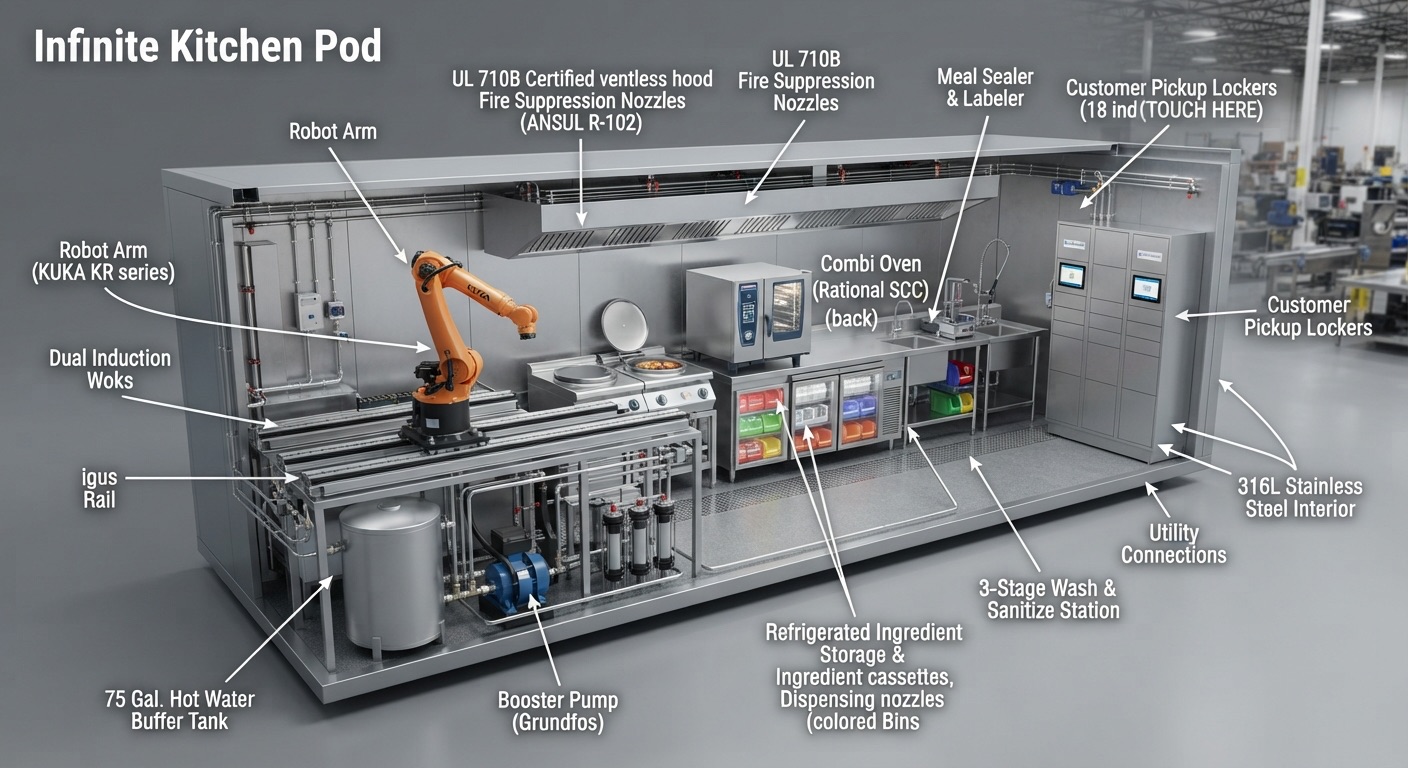 Fig 04 / Cutaway
A whole kitchen, opened up.
Three zones in one enclosure: cold storage, the cooking and cleaning cell, and dispatch. The main parts in the current BOM:
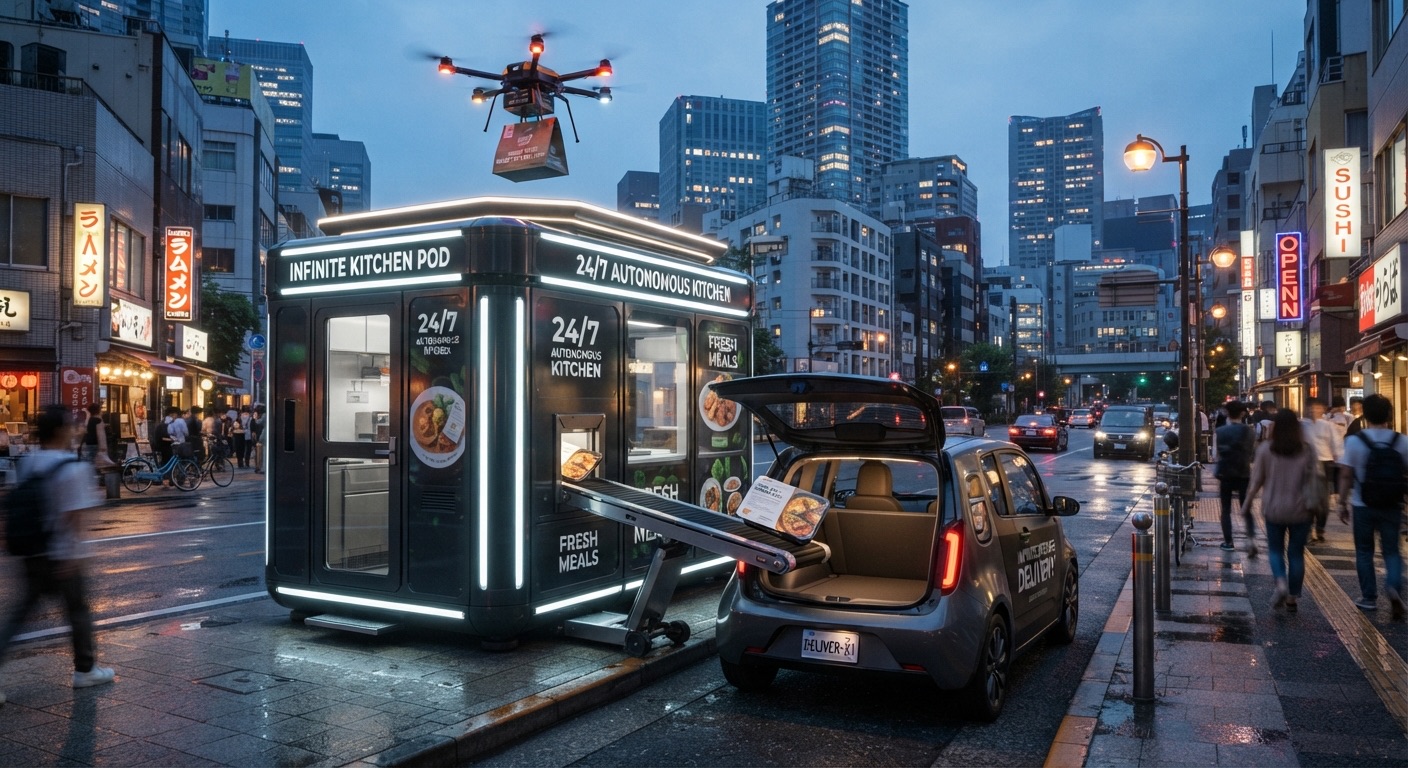 Fig 05 / Delivery
Sealed, labeled and on its way.
Every meal is heat-sealed and labeled, then handed off without anyone touching it.
- Vehicle bay: a side pass-through drops meals into a delivery vehicle.
- Rooftop pad: an internal lift carries sealed meals up for drone dispatch.
- Ground robots: an airlock conveyor hands off to delivery robots.
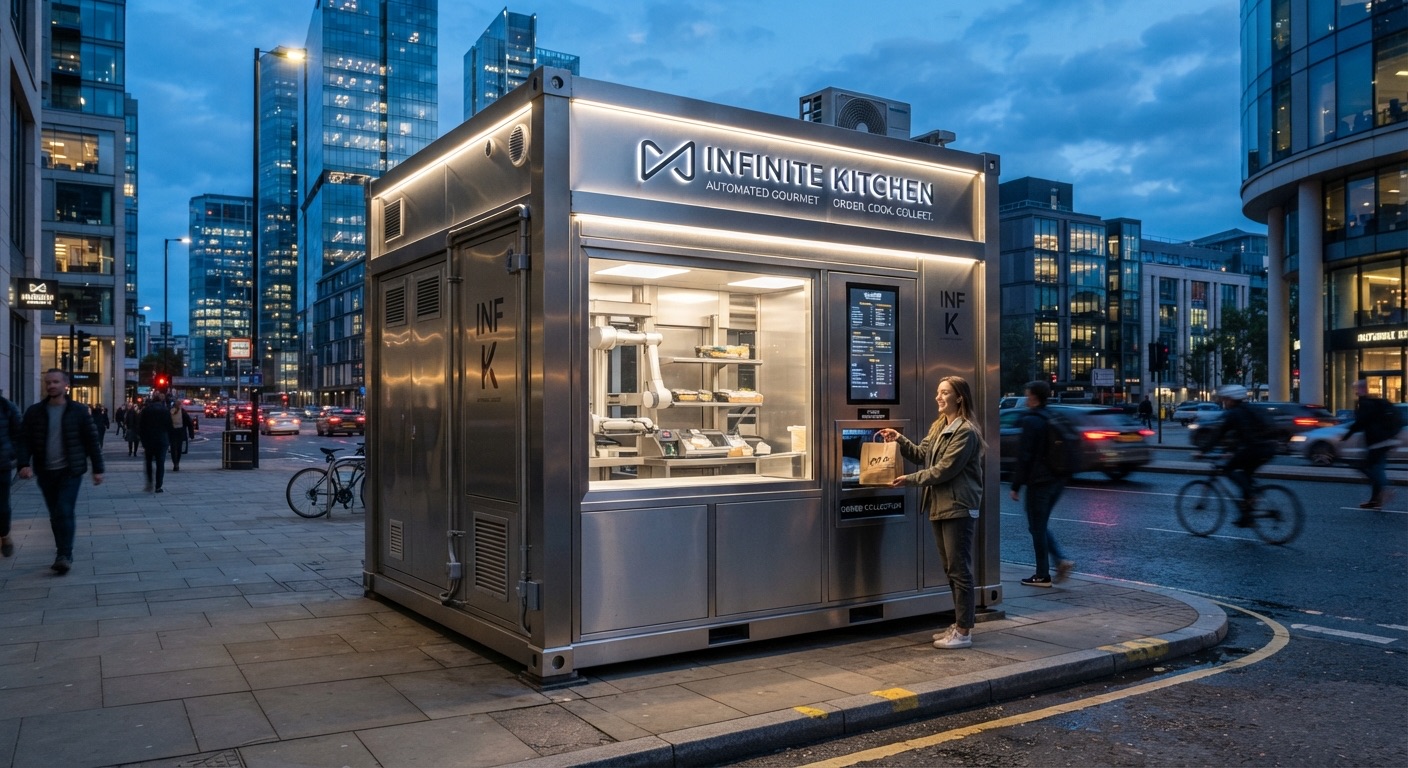 Fig 06 / Exterior
120 square feet. All electric.
One pod is 12 ft by 10 ft and 9.5 ft tall, about 120 square feet. It runs on 480V 3-phase power with no gas line, and its own ventless hood means no ductwork and no restaurant lease.
- Self-contained: power, water and drain in, meals out. No gas hookup.
- Stainless frame with insulated, washable panels.
- Some older docs still list other sizes and power; help bring them in line.
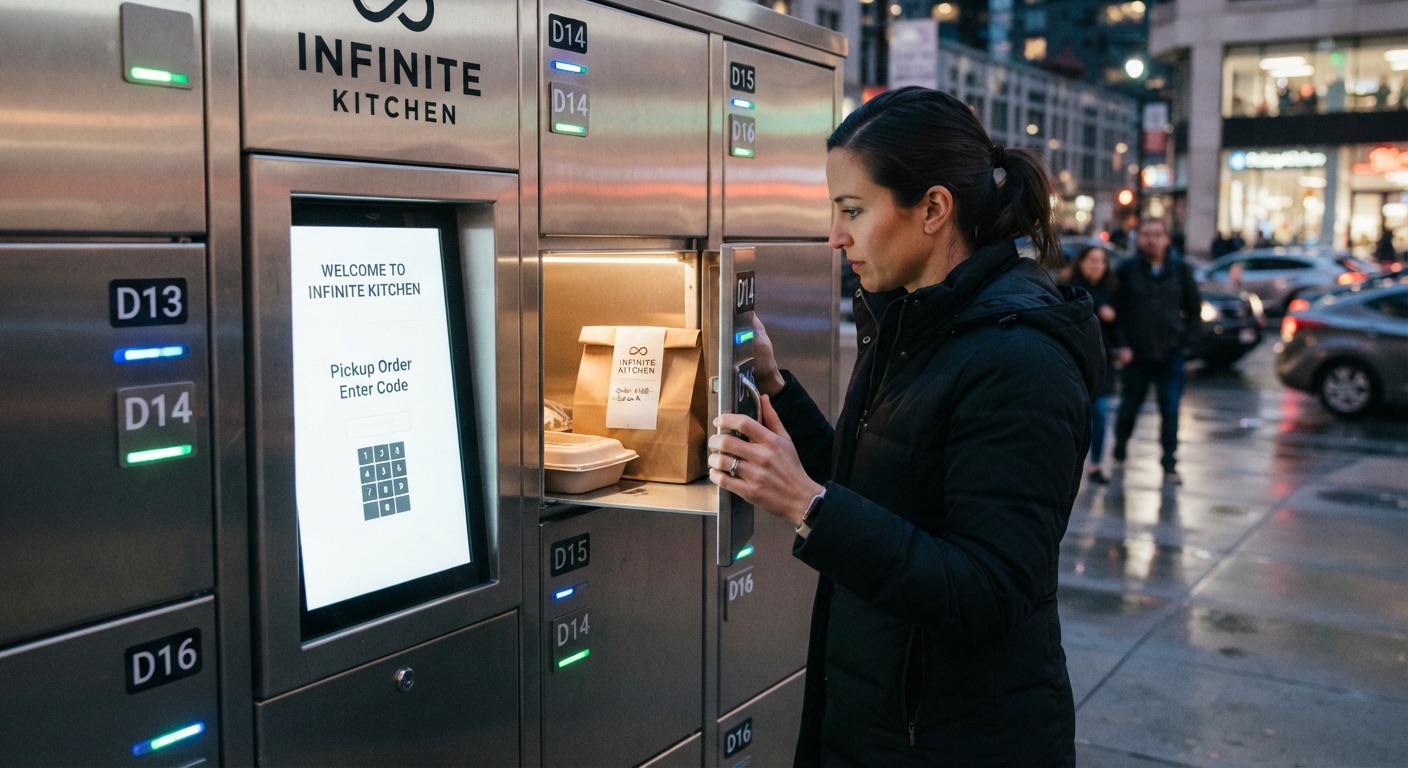 Fig 07 / Lockers
Scan, open, eat.
Walk up, scan a code and your meal is waiting at the right temperature. No line, no counter, no tip screen.
- Dual-climate lockers: 140°F hot and 38°F cold.
- Mobile QR pickup straight from the order.
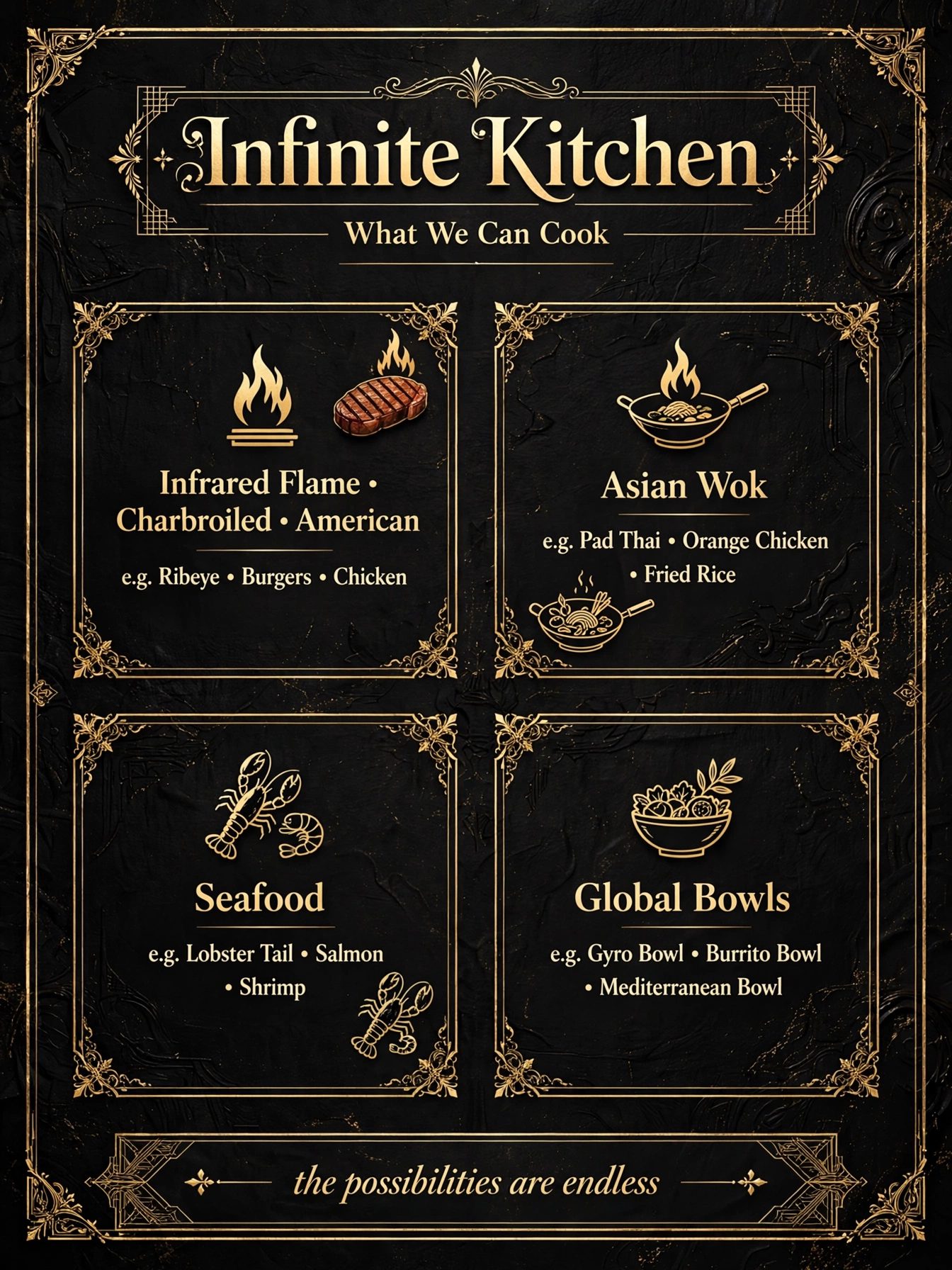
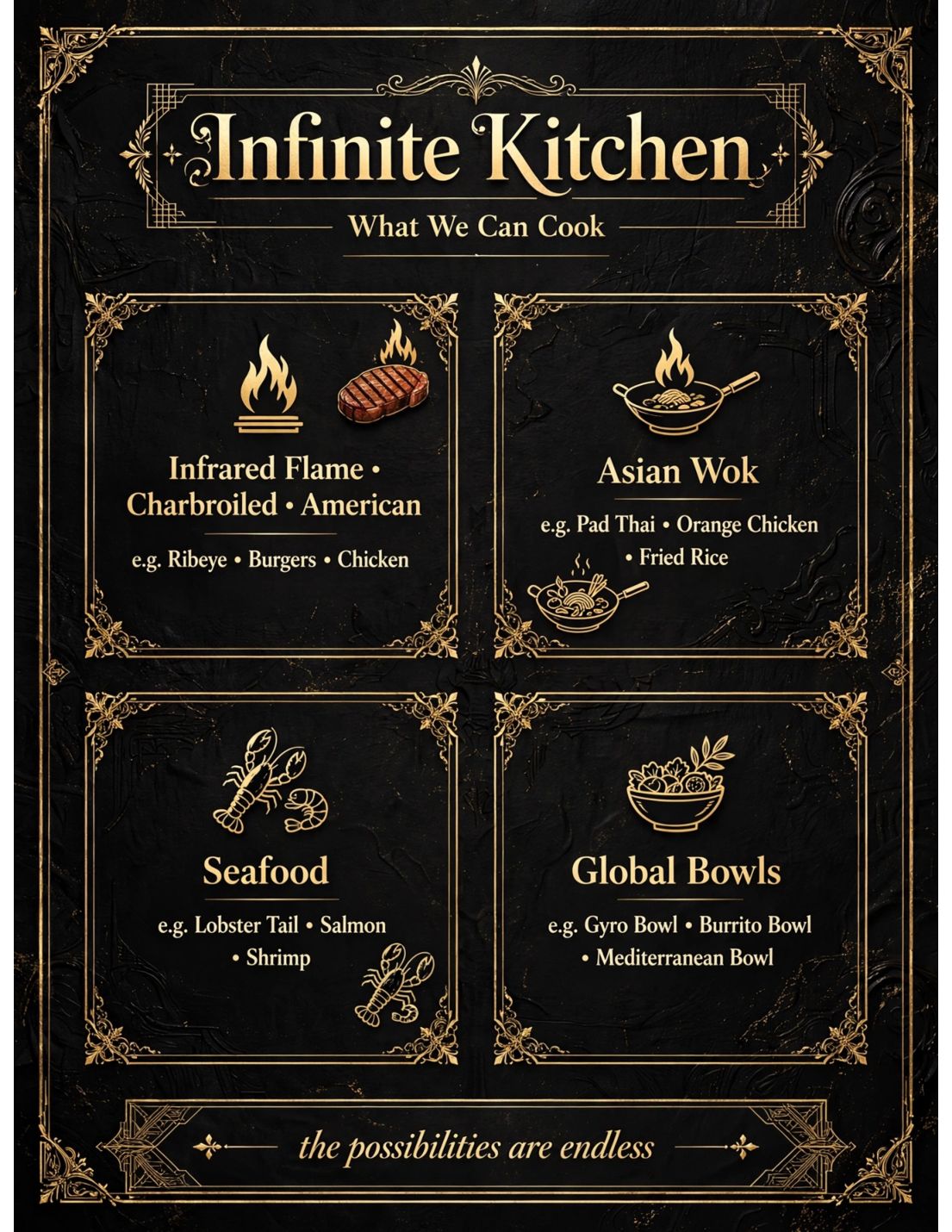
One kitchen, four cuisines.
The same pod switches between a charbroiler, two woks and a multi-cook oven, so one menu can cover a steakhouse, a wok bar and a bowl shop.
Flame charbroiled American
Ribeye, burgers, chicken
Asian wok
Pad thai, orange chicken, fried rice
Seafood
Lobster tail, salmon, shrimp
Global bowls
Gyro, burrito and Mediterranean bowls
Others automate a station. This is the whole kitchen, in the open.
Companies are automating kitchens with closed designs, and most of them automate one station inside a kitchen someone already built. As far as we can find, nobody has published an open, end-to-end design like this one. Fewer rented robots and less buildout means lower menu prices with the same good ingredients.
Infinite Kitchen Pod
Miso Robotics, Flippy
Botinkit, ChefBot
Hyper Food Robotics
Nala Robotics, Pizzaiola
Moley Robotics
Competitor prices are snapshots from public reporting and change over time. Details in docs/competition.md.
Deploy as a pod, or drop it into an existing kitchen.
Either way, money not spent on buildout and rent is money that never has to be charged for the meal.
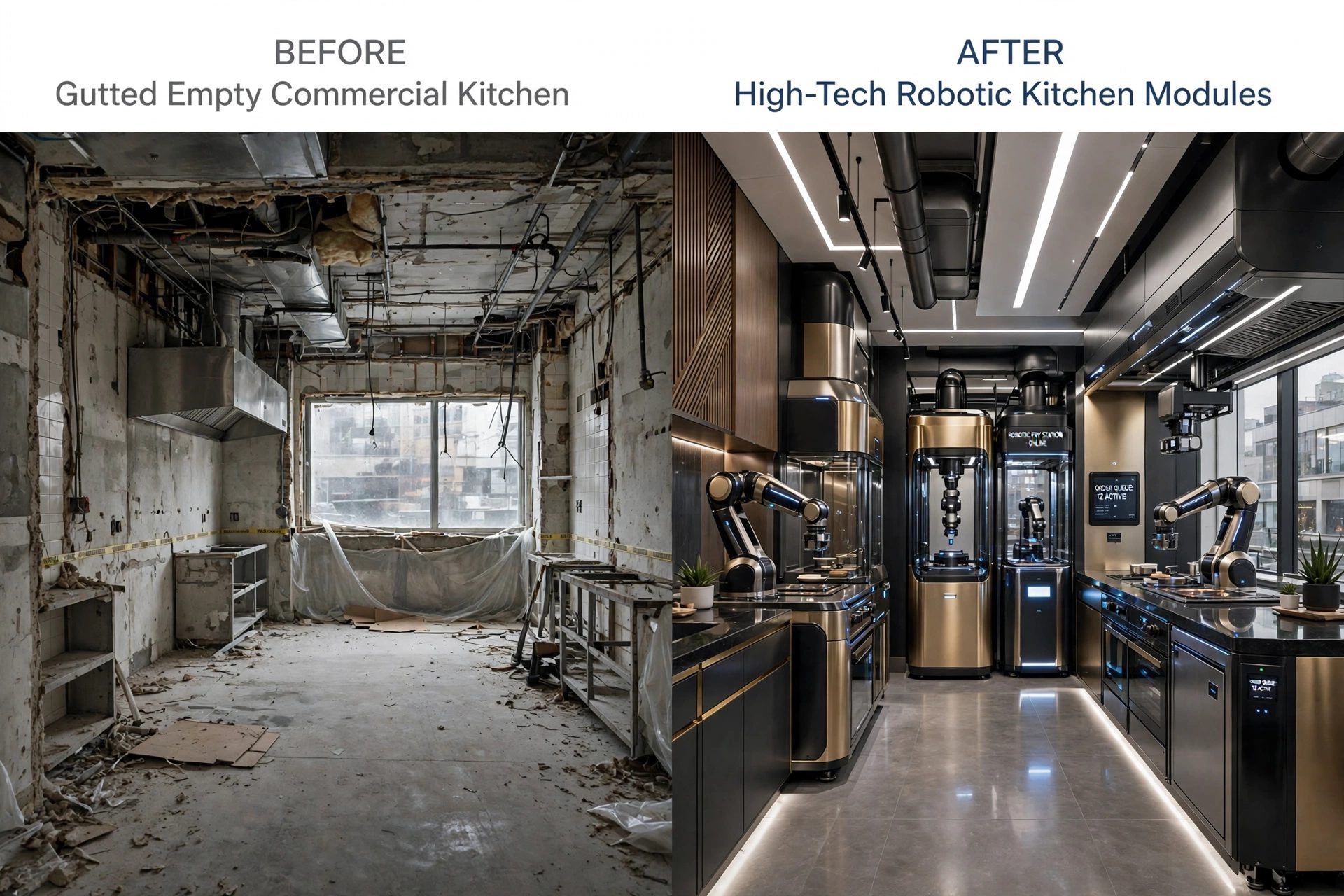 Before / after
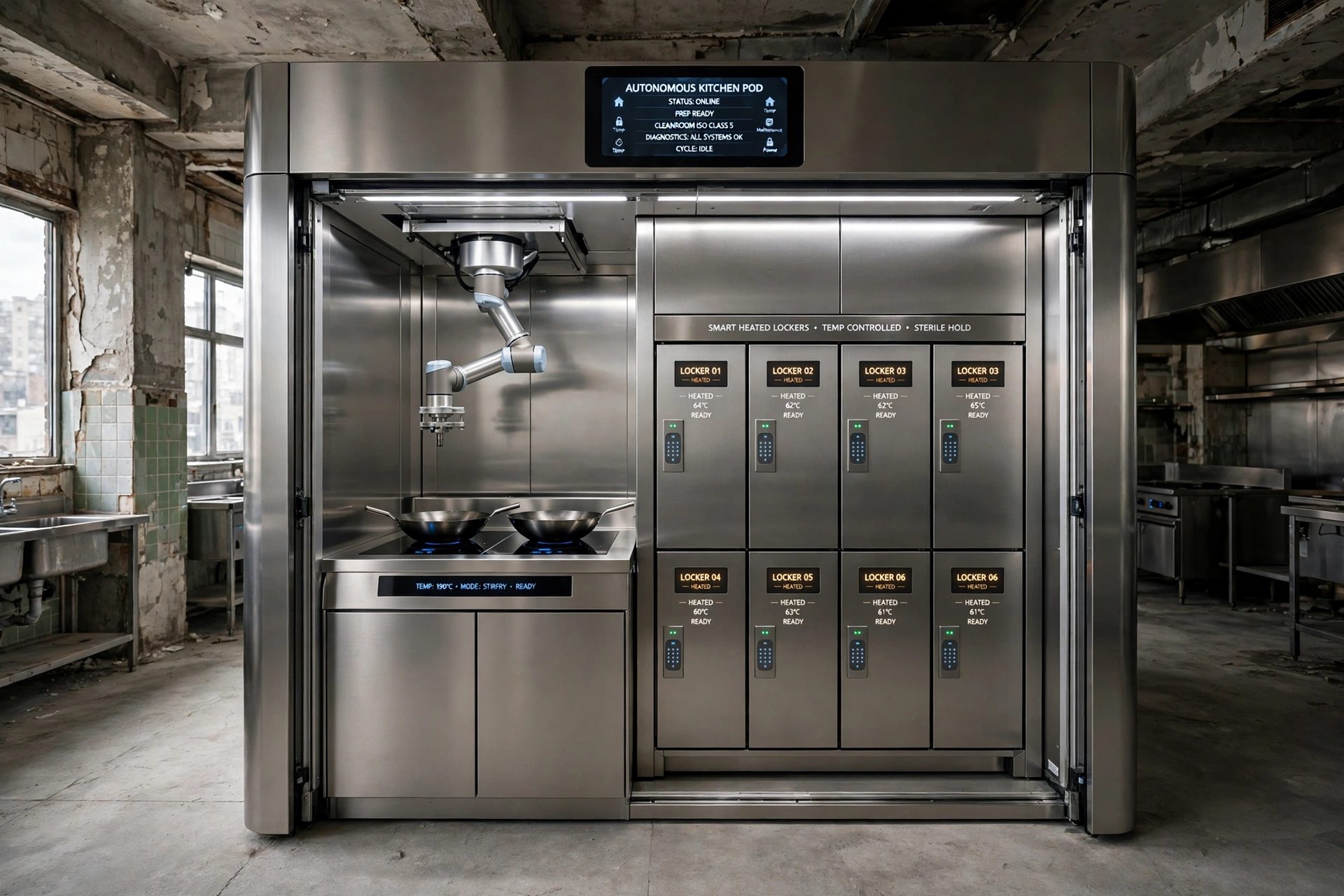 Pod in a gutted kitchen
A gutted restaurant space that still has its hood, fire suppression, grease trap and plumbing. The cooking cell drops in and reuses all of it, skipping most of the buildout. The tradeoff is a lease and an older hood that may need bringing up to code.
Its own UL 710B ventless hood and clean-in-place system let it sit on a sidewalk, in a parking lot or any small, low-rent footprint with power, water and a drain.
Buildout savings are general estimates, not quotes. Details in docs/retrofit-existing-kitchen.md.
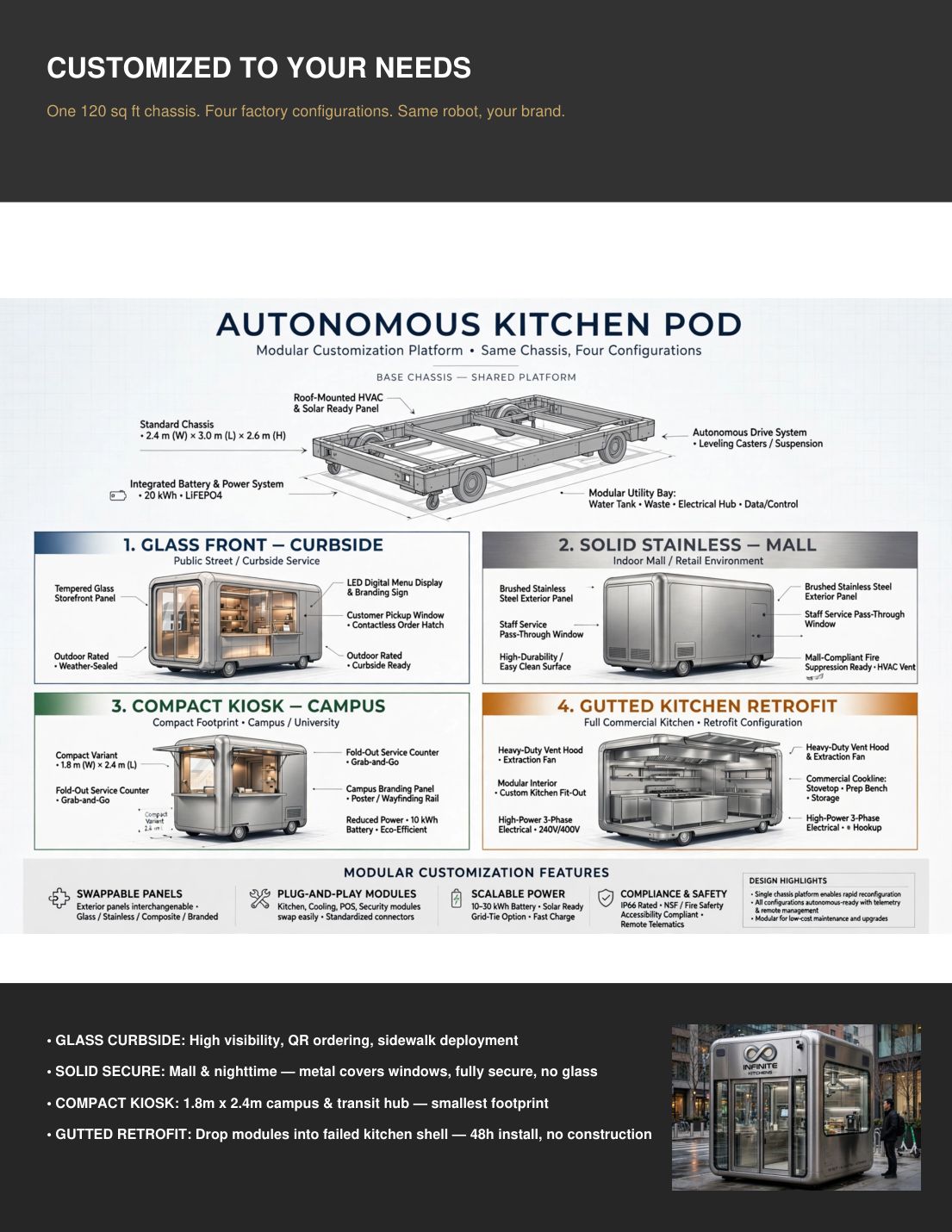
One chassis. Four configurations.
Same robot, same kitchen, your brand. Panels and modules swap so the pod fits the site.
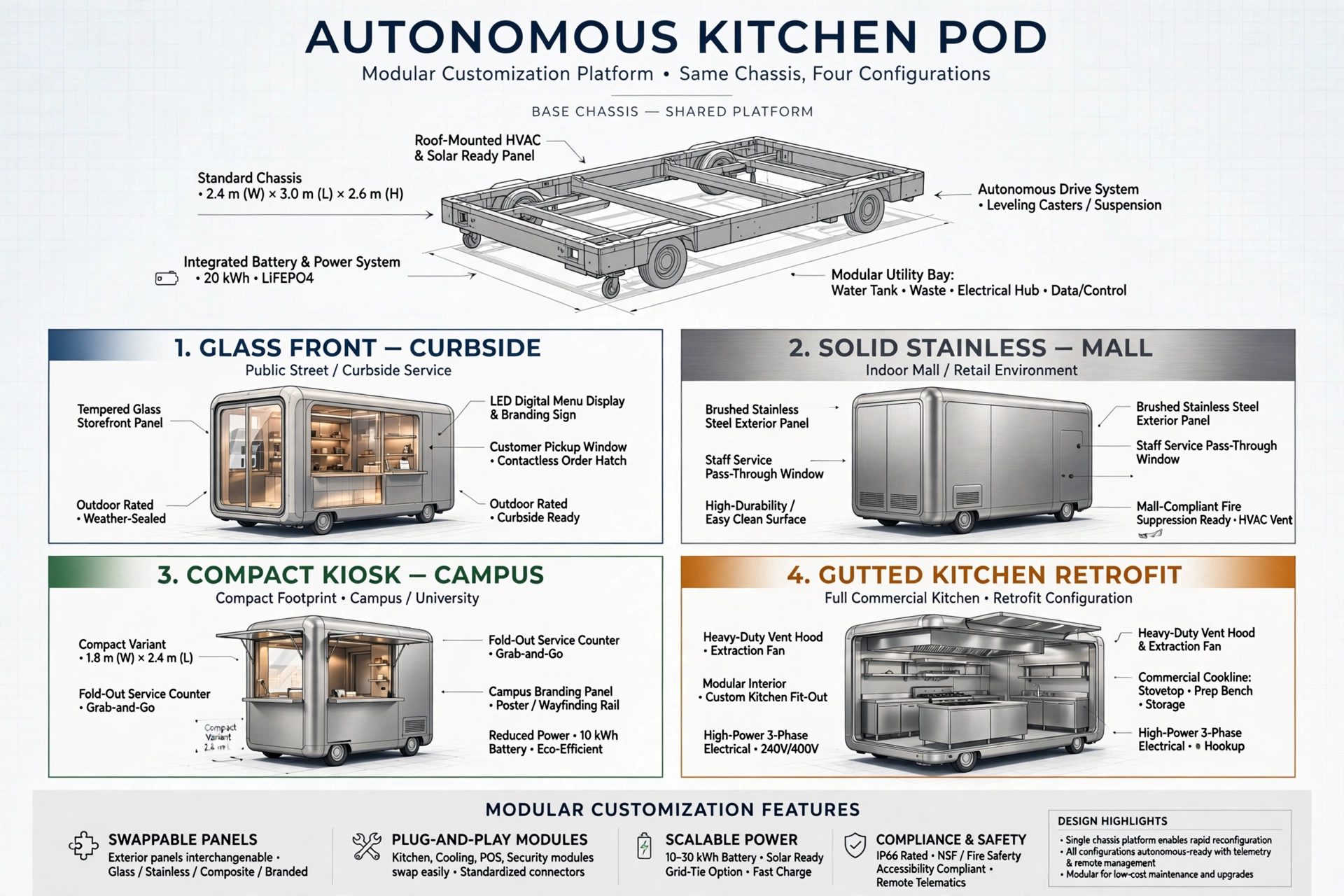
Glass curbside
High visibility, QR ordering, sidewalk deployment.
Solid secure
Malls and nighttime. Metal covers the windows, no glass.
Compact kiosk
1.8 m x 2.4 m for campuses and transit hubs.
Gutted retrofit
Modules drop into a failed kitchen shell. 48 hour install, no construction.
Buy it outright, or run it as a service.
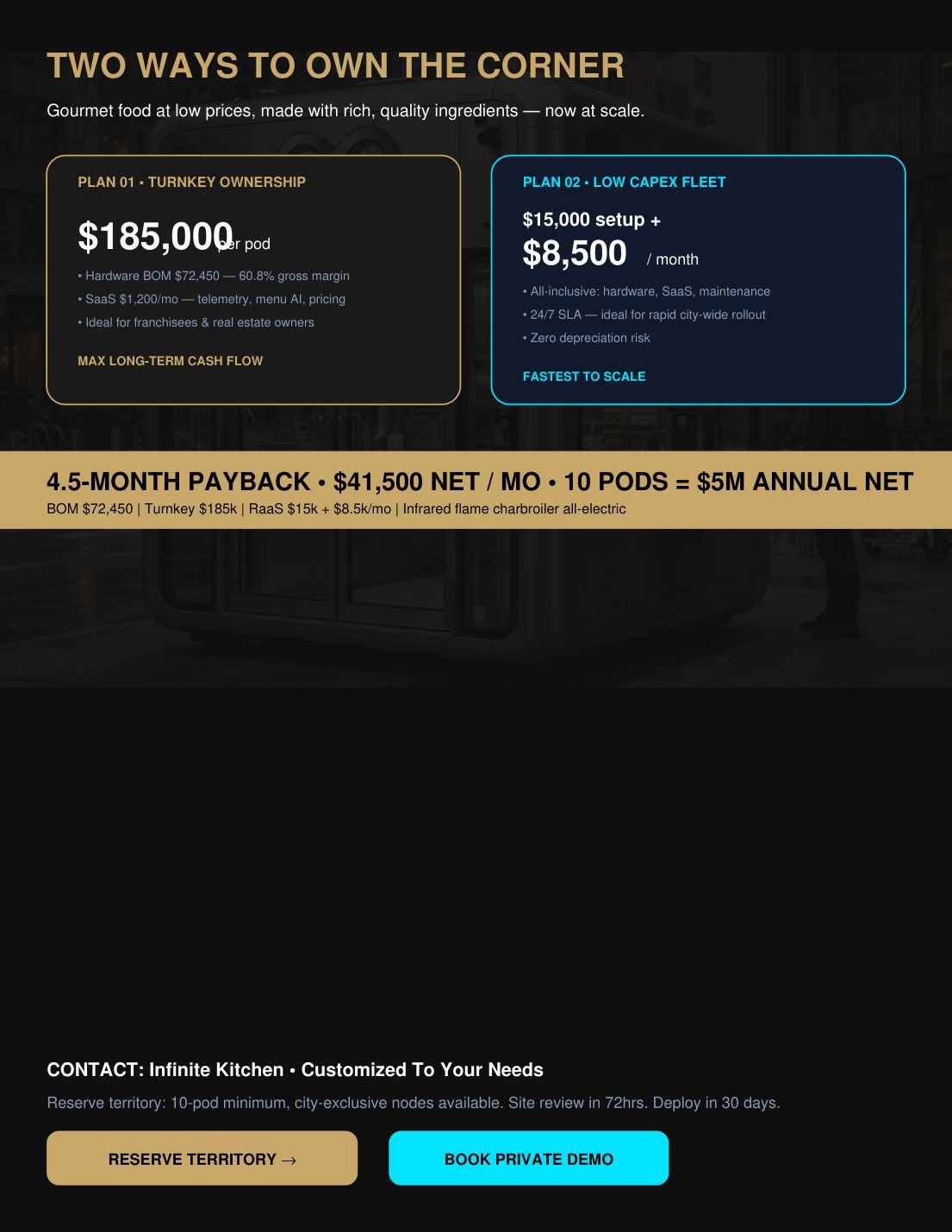
Two plans in the brochure, both early estimates. Either way the operator's costs stay low, so the menu prices can too.
Own the hardware. A $1,200 a month cloud platform fee, a 4.5 month simple payback in the brochure model, and the most cash flow over the long run.
Low upfront cost. Hardware, software, telemetry, preventive maintenance and replacement parts are all in the subscription, which suits fast fleet growth.
Plan details are on page 6 of the investor brochure (PDF).
Every angle.
Seven pages. The full picture.
The food, the steakhouse menu, four configurations, the cutaway and retrofit, two ways to own, and everything it can cook. Swipe through it here, or download it.
Prefer a web page? There is also an HTML version of the earlier brochure. Every number in the PDF is written out in docs/brochure.md.
Read the spec.
Everything is public: check the math, find the holes, make it better.
Investor brochure
Seven pages: the food, the menu, configurations, cutaway, plans and cuisines.
TextBrochure, every number
Menu prices, configurations, plans and cuisines written out.
PDFRevised CAD and BOM
Layout, bill of materials, P&L and the 3-stage sanitation protocol.
AuditTechnical audit
Water heating, arm timing, BOM, P&L, hood and fire, materials, allergens.
SpecClean-in-place blueprint
Sanitation hardware, fluidics, wiring and the regulatory matrix.
Interactive 3DCIP hardware viewer
Spin and explode the clean-in-place hardware in your browser.
MarketHow it compares
Commercial kitchen robots and what they cost, with sources.
DeployPod or existing kitchen
What reusing a second-generation kitchen saves, and the tradeoffs.
Here's what isn't solved yet.
No prototype exists yet, and these are real open problems. Each one is an open issue. If you know the field, jump in.
Hot water buffer sizing
Each full clean-in-place run needs about 142 gallons of 180°F water. The tank holds 75.
Single-arm, dual-wok throughput
38 seconds a meal works on paper. It needs a prototype to prove it.
BOM and the $185k price
Early estimates from list prices. Real quotes wanted.
Hood and fire suppression
Integrating the UL 710B ventless hood and UL 300 suppression with the robot cell.
Material choices
Induction wok metal, peristaltic tubing, and the arm's washdown rating.
Allergen carryover
The wash protocol needs real carryover testing between meals.
Certification path
NSF 4/7, UL 197/471/508A, R15.06 / ISO 10218.
Reconcile the numbers
Footprint, amperage and finance figures differ across the docs.